
Introduction
Collaborative research is central to a learning health system (LHS) approach that relies on the conversion of routinely collected health data into knowledge and interventions to support timely, evidence-informed decisions that improve healthcare delivery and health outcomes.1,2 To address complex health system challenges, particularly in South Africa with its quadruple disease burden and resource constraints, the integration of disciplinary expertise, tacit practice-based knowledge, and methodological research expertise is required.1 Research partnerships often entail the active engagement of university-based researchers with stakeholders across disciplines and sectors to achieve shared scientific and society goals.2 Collaborative research platforms that integrate research, practice-based data, and frontline practice support iterative evidence generation and continuous improvement, and serve as a mechanism for collective learning. Such research has gained prominence in health systems research because it enables deeper insight into real-world contexts and complex health system dynamics, while enhancing the relevance, uptake, and sustainability of research evidence.3
However, the formation and sustainment of effective collaborations remains complex, frequently shaped by power relations, competing priorities, and, at times, implicit or hidden agendas.2,4 Several reflective accounts of collaborative research initiatives in South Africa provide important insights, including early stakeholder engagement, development of trusting relationships, ensuring that research is perceived by overburdened clinical partners as directly applicable to routine decision-making, and early planning to embed evidence within existing systems to ensure sustainability.5–7
While each research collaboration occurs within a unique context, common lessons can be drawn from diverse cases. Documenting these insights, including enabling and constraining factors from both successful and unsuccessful collaborations, is important for informing the design and implementation of effective and sustainable collaborative research models and as a mechanism for stakeholder engagement in continuously generating knowledge to address complex health problems. It is particularly important to explore collaborations that involve nurses since they are central to healthcare delivery in the South African healthcare system. This paper presents an analysis of six research collaboration cases involving nursing-qualified academics, academics from other disciplines, nurse educators, and healthcare practitioners working across higher education institutions and healthcare organisations in South Africa. The aims of the research were to explore how individual, team, leadership, and contextual factors influence sustained commitment and outcomes in collaborative research in nursing and health care in South Africa to provide guidance to enhance the effectiveness and sustainability of research collaborations.
Method
A qualitative multiple case study approach was used whereby two academic researchers wrote narrative reflections on successful and unsuccessful cases of research collaborations. Employing a multiple case study approach enabled the phenomenon to be explored in different real-life contexts.8
Case selection
The six cases comprised purposively selected collaborative research projects in which the authors held active roles. A purposive polar case sampling strategy9 was used to select cases from the approximately 18 cases experienced by the authors during their careers as academics in higher education institutions. Each case was treated as a bounded unit of analysis defined by a distinct research collaboration. Contextual variations and diverse outcomes allowed exploration of common patterns, variations, and limits of influencing factors. The case inclusion criteria were: (1) at least one author was required to have had direct, in-depth and continued involvement in the collaborative initiative, spanning from its initiation through to the attainment of outcomes or, where applicable, project termination, thereby ensuring access to rich in-depth experiences; (2) the case should have involved collaboration aimed to build research capacity among those involved in healthcare research, education and practice; and (3) the case should have had either a successful outcome including presentation at a conference or publication of the results in scientific peer-reviewed journals (successful case), or had been terminated and consequently did not work through the full research process until dissemination of the results (unsuccessful case). There was no specific limit on the length of the collaboration. Four successful and two unsuccessful cases were selected.
Characteristics of the six cases
The characteristics of the six cases and the outcomes of their collaborations are outlined in Table 1.
The six cases reflect a range of healthcare research collaborations undertaken in South Africa between 2017 and 2025, each involving at least one nursing-qualified academic as a researcher. The cases varied in their composition and focus. Two cases (C1 and C4) engaged clinical practitioners as co-researchers, situated within wound care and mental healthcare settings, respectively. Case 1 was interprofessional in nature, bringing together nurses and medical doctors, while C2 extended across four disciplines: social work, occupational therapy, nursing, and medicine, with the additional involvement of a private company, making it the most interdisciplinary of the six. In contrast, C3 and C6 were intradisciplinary, involving nursing-qualified academics exclusively. Case 5 centred on building research capacity among nurse educators within a college setting. In terms of research focus, C3 and C6 addressed research methodology, C1 and C2 sought solutions to clinical healthcare problems, and C4 and C5 aimed to strengthen evidence-based practice by developing research skills among mental health practitioners and nurse educators (in both the academic and clinical setting), respectively. Therefore, diversity existed on multiple levels, spanning the disciplinary composition of teams, the nature of partnerships (academic–academic, academic–clinical, and academic–industry), the professional roles of collaborators, and the focus of the research itself.
Data collection
The data consisted of narrative reflections developed by the authors based on their direct involvement in the six cases. One author reflected on two cases and the other on four cases. These reflections occurred independently and retrospectively. The describe, examine, and articulate learning (DEAL) framework as presented by Huber and Hutchings10 guided reflection and allowed for systematic documentation of the authors’ experiences. The DEAL framework, developed within experiential and reflective learning traditions, is widely used in higher education to structure reflection on lived experience. Its purpose is to move reflection beyond description by systematically linking experience to meaning making and the articulation of learning.11 In this study, authors first described their experiences of each collaboration, including key events, contexts, and observed successes and challenges. They then examined these experiences from multiple perspectives including professional development, civic learning, and personal growth dimensions. Finally, they articulated learning in the form of transferable insights and implications for future practice. The DEAL framework is particularly suited to contexts where participants are directly embedded in the phenomenon under study, as it enables rigorous, systematic reflection while maintaining proximity to the lived experience.
As the six cases were purposively selected and formed a bounded dataset, conventional notions of data saturation were not applicable. Instead, the analysis focused on analytic completeness, with cross-case comparisons demonstrating recurring patterns and sufficient thematic redundancy to support the final themes.
Data analysis
An inductive, cross-case thematic analysis was conducted to identify common and unique patterns in collaboration processes, outcomes, and influencing factors. The analysis process was guided by the data analysis spiral of Creswell and Poth.12 Narrative reflections were uploaded into ATLAS.ti (v.25) for coding. To enhance analytic rigour, coding involved both AI-assisted coding as an independent analytic process and researcher-led coding, during which the authors scrutinised, refined, and supplemented the AI-generated codes. The authors then engaged in an iterative process of code comparison, classification, merging, theme development and refinement, culminating in the representation of findings in a thematic summary table (Table 2). The analysis deepened the understanding of the ‘how’ and ‘why’ of the phenomenon.13 Although AI-generated codes were used, the interpretation and synthesis of findings remained the responsibility of the researchers.
Ethical considerations
Ethical clearance was obtained through the University of South Africa College of Human Sciences Research Ethics Committee [1983180_CREC_CHS_2025].
Findings
Five themes emerged from the data: (1) dynamics of the research collaboration process; (2) outcomes of collaborative research; (3) individual influences on engagement and collaboration; (4) team performance; and (5) leadership in collaborative research. Each theme had several sub-themes as outlined in Table 2.
Theme 1: Dynamics of the research collaboration process
All cases represented dynamic and complex processes occurring over varying timeframes, ranging from one to six years. Multiple collaborators introduced contextual and relational dimensions in addition to the inherent complexity of research. The sub-themes reflect the different drivers of functioning within the collaboration process, including relational and perceptual factors that influenced sustained commitment, structural and procedural factors and the need for clarity of roles and processes.
Sub-theme 1.1: Sustaining commitment through relational and perceptual factors
The analysis showed that sustained commitment throughout the dynamic research collaboration process is essential for achieving intended outcomes. Sustained commitment refers to the ongoing investment of time, resources, and relational engagement by collaborators beyond initial agreement. Across successful and unsuccessful cases, commitment was shaped by relationships and perceptions of research. Similar factors that represent at an individual level are reported in Theme 3. However, this sub-theme highlights sustained commitment as a central concern.
In both C1 and C3, the nature of the relationship among collaborators influenced sustained commitment. In C3, a strong long-term relationship enabled the collaboration to continue despite the illness of a researcher. Similarly, in C1, positive relationships and teamwork sustained progress when one team member struggled to maintain momentum: “Two members also supported the writing of the paper especially during a time when it became difficult for the leading researcher to complete the paper due to PhD responsibilities”, (reflection on C1, successful case).
Perceptions towards research and the research project’s alignment with stakeholders’ interests influenced sustained commitment. In C5, although the project was successful, the influence of the perceptions of research at both individual and organisational levels were evident, with the organisation not fully embracing a research-oriented culture: “Although they enjoy the research activities, they do not regard the teaching of research as an important subject. This points to the research culture that is not entirely embraced”, (reflection on C5, successful case).
From the two unsuccessful cases, retirement and illness which changed personal interest and priorities, both contributed to extended timelines and disengagement. In contrast, in C3, although one researcher fell ill, the other two researchers were committed: “Since two of the collaborators have a long-standing relationship, my absence did not negatively affect the team dynamic”, (reflection on C3, successful case). Collaborators in C4 and C5, particularly nurses in clinical practice outside higher education, whose professional contexts offered limited incentives for scholarly publication, were sometimes less able to sustain commitment to project timelines and publication-related responsibilities.
Sub-theme 1.2: Keeping momentum through structural and procedural factors
Alongside strong relationships and positive perceptions of research, effective structures and procedures must be established within the dynamic collaborative research process. An effective collaborative structure should incorporate regular scheduled communication and clearly defined goals and timelines. For example, in C2 and C6 (both unsuccessful), the absence of a formal structure and clearly defined timelines resulted in limited accountability: “However, the group work was not structured enough, and timelines were not communicated and kept strictly”, (reflection on C2, unsuccessful case).
However, sufficient flexibility remains essential, as collaborators manage multiple professional and personal commitments. In some of the successful cases, multiple communication platforms were used with a combination of face-to-face and online sessions. For example, in C1, a shared online Dropbox enhanced data management and transparency.
Sub-theme 1.3: Clarity of roles, interests, values and processes
The findings from both successful and unsuccessful cases indicated that explicit delineation of collaborator roles, interests, values, and operational processes represented a key determinant of effective collaborative functioning. Reflection on challenges during C1 and C6 indicated that formalisation of the roles within a memorandum of agreement is advised to support shared understanding and accountability. Clarifying and providing training on methodological processes was particularly important when collaborating with novice researchers: “There was a lot of uncertainty especially with the appraisal process since members were not familiar with research methodologies … I learnt than more training would be a benefit, especially providing training on the overall process (systematic review method) and an overview of various quantitative and qualitative methods for quality appraisal …” (reflection on C1, successful case).
Theme 2: Outcomes of collaborative research
The second theme relates to the outcomes of the collaborative research as achieved in the successful cases. However, even in the unsuccessful C6, where the research was neither complete nor published, some findings were transferable to other projects, demonstrating the broader value of the generated data.
Sub-theme 2.1: Knowledge dissemination and use
The successes of the effective cases included disseminating evidence through scholarly publications and conference or symposium presentations, with conference attendance also reinforcing commitment as seen from C1 and C4: “The pressure to complete the project before the international conference was an advantage since it was an incentive to commit and complete the work on time”, (reflection on C1, successful case).
Sub-theme 2.2: Capacity building, advancement of scholarship, and cultivation of a research culture
Individual research capacity was strengthened through engagement in the collaborative research cases aligned with a capacity building intent, namely in C1, C3, C4 and C5. For example, individual capacity building led in C5 to enrolment in postgraduate degrees, fostering scholarly development. The impact of the collaborative research process on the partner organisation’s research culture was also observed in C4 and C5 as longer-term projects.
Theme 3: Individual influences on engagement and collaboration
This theme centred around the individual-level determinants that shaped engagement and commitment.
Sub-theme 3.1: Knowledge and expertise
Limited knowledge of research methods and processes was observed among novice nurse educators (C5) and partners from clinical practice (C1 and C4). This sometimes resulted in reduced levels of interest and uncertainty. However, this did not necessarily result in failure of a project but rather led to the articulation of learning from the cases: “However, I soon realised the lack of knowledge of all the categories of nurses. It became my own challenge to develop material that was both factual and creative in order to stimulate their interest in research”, (reflection on C4, successful case).
Sub-theme 3.2: Emotional, motivational, and contextual factors
Interest, excitement, and intrinsic motivation shaped the commitment levels of both the leader and collaborators, with initial enthusiasm typically high at the start of the project, even for unsuccessful cases such as C2: “There were times of excitement for the prospects of the project, but also a lot of uncertainty, especially in terms of role clarity”, (reflection on C2, unsuccessful case). However, without continued commitment, success was not achieved. At an individual level, it was found that emotions, motivation, and individual circumstances influenced sustained commitment to the collaboration.
External motivators, such as gifts or performance requirements, may have encouraged participation. However, sustained commitment was limited unless intrinsic motivation was activated. Ill health, especially of the leader, affected sustained commitment as identified from C2 (unsuccessful) and C3 (successful). Personal circumstances also influenced engagement, even in otherwise successful collaborations, while retirement directly halted contributions.
Sub-theme 3.3: Ethical conduct
Ethical conduct was identified as an individual factor that influenced teamwork and trust. While differing viewpoints can enhance learning, as seen in unsuccessful C2, they may erode respect if discussions are not carefully managed: “There was a lot of debate about the definitions of concepts. This was very insightful and necessary to ensure a common understanding. However, respect for each other is essential …”, (reflections on C2, unsuccessful case).
In C5, unethical conduct by an individual was encountered and adversely affected relationships, although the incident also provided an opportunity for reflection and learning.
Theme 4: Team performance in collaborative research
Team composition and shared decision-making were identified as key influences on the team’s performance.
Sub-theme 4.1: Team composition
Team composition differed across cases. Three cases included academic-academic collaborations which facilitated progress, knowledge sharing, and interdisciplinary debate. However, in C2, limited access to partners from clinical practice was a barrier:
“Involvement of a person from practice was missing, since we often, as academics, struggled to understand how the intervention can work in clinical practice”, (reflection on C2, unsuccessful case).
Across the cases, it was evident that a balanced mix of complementary skills and knowledge enhanced shared learning, quality, relevance, and project progress.
Sub-theme 4.2: Shared decision-making
Relationships were strengthened through shared decision-making and, where appropriate, consensus-building, as these approaches helped mitigate power imbalances: “Adjustments to the protocol or timeline were discussed in the group and consensus was reached on changes”, (reflections on C1, successful case) and: “I have learnt that good relationships and equal roles enhance the research and publication process”, (reflections on C3, successful case). In the two unsuccessful cases (C2 and C6), persistent non-response prevented shared decision-making, including the decision to discontinue the project after a prolonged period of inactivity: “This unsuccessful collaboration was frustrating, not only because of the slow or non-response but also because I discontinued the project”, (reflections on C6, unsuccessful case).
Theme 5: Leadership in collaborative research
Key factors in the leadership of collaborations were identified and organised into two sub-themes.
Sub-theme 5.1: Leader attributes
Common leadership attributes necessary for ongoing adaptive decision-making to sustain project momentum and preserve trusting relationships were identified as: empathy and self-directedness, strong self-awareness, perseverance, assertiveness, resilience and patience. Reflections on personal growth arising from the unsuccessful cases also informed the identification of the leadership attributes.
Empathy during periods of non-performance and appreciation of collaborators’ contextual constraints such as the demands of patient care (C4, successful), were particularly important, especially for novice researchers or when institutions lacked a supportive research culture (C3, successful).
Sub-theme 5.2: Emotional experiences
The authors, as project leaders, experienced many tensions and emotions during the ongoing process in both successful and unsuccessful cases. This included uncertainty, fear of failure, imposter syndrome, frustration, disappointment, regret, guilt and loss of motivation: “I was afraid that the members would quit because it was too much work and too abstract. I was also frustrated that the process took such a lot of my time … This led to feelings of guilt”, (reflections on C1, successful case).
Positive emotions reported included joy and excitement: “I was excited about what we were creating”, (reflections on C1, successful case) and: “The involvement allowed me to enjoy the visible growth in research culture”, (reflections on C5, successful case). Leading collaborative projects also fostered substantial personal growth, contributing to a sense of self-actualisation.
Discussion
The findings indicate that successful research collaborations are underpinned by sustained commitment, which is shaped by relational, structural, and individual factors, including the nature of relationships, perceptions of research, alignment with interests, engagement structures, role clarity, existing knowledge and expertise, motivation, trust and ethical conduct, team composition, shared decision-making, and leadership attributes. Planned outputs, such as conference participation and co-authorship, also function as reinforcing motivators. Successful collaborations resulted in knowledge dissemination, capacity building, scholarly advancement, and in some cases, the development of a research culture in organisations. Although unsuccessful collaborations did not achieve intended outcomes, they generated insights.
The finding that successful research collaborations are shaped by relational, and structural factors is well supported by the literature.14,15 There is a mix of evidence on the influence of individual and leadership factors.16 While literature provides extensive theoretical and empirical evidence on international collaborative research, emphasising the importance of stakeholder engagement, effective communication and role clarification for commitment and teamwork, frameworks do not clearly include strategies for sustainability and ongoing partnership.17 South African scholarship is more limited and largely comprises case-based frameworks and models of collaborative partnerships.18,19
This study contributes a unique perspective on research collaborations involving healthcare academics including nursing-qualified academics in higher education, healthcare practitioners, organisations and nurse educators within a South African research capacity-building context. Cases were interprofessional, interdisciplinary and intradisciplinary in nature and offer case-based insights that can be further tested, refined, or challenged in future studies.
A conceptual framework for sustaining collaborative research in nursing and health care
A conceptual framework for sustaining collaborative research in nursing and health care was developed by the authors based on the findings derived from the six reflective case studies (Figure 1). The identification of concepts, the interpretation of their meaning, and the relationships depicted between concepts were determined by the researchers through an iterative process of discussion and refinement. An artificial intelligence (AI) application was used as a graphic design tool to assist in the visual presentation of the framework. The AI outputs were reviewed, modified where necessary, and approved by the authors to ensure that the final infographic accurately reflects the researchers’ conceptualisation. AI did not contribute to the interpretation or theoretical development of the framework.
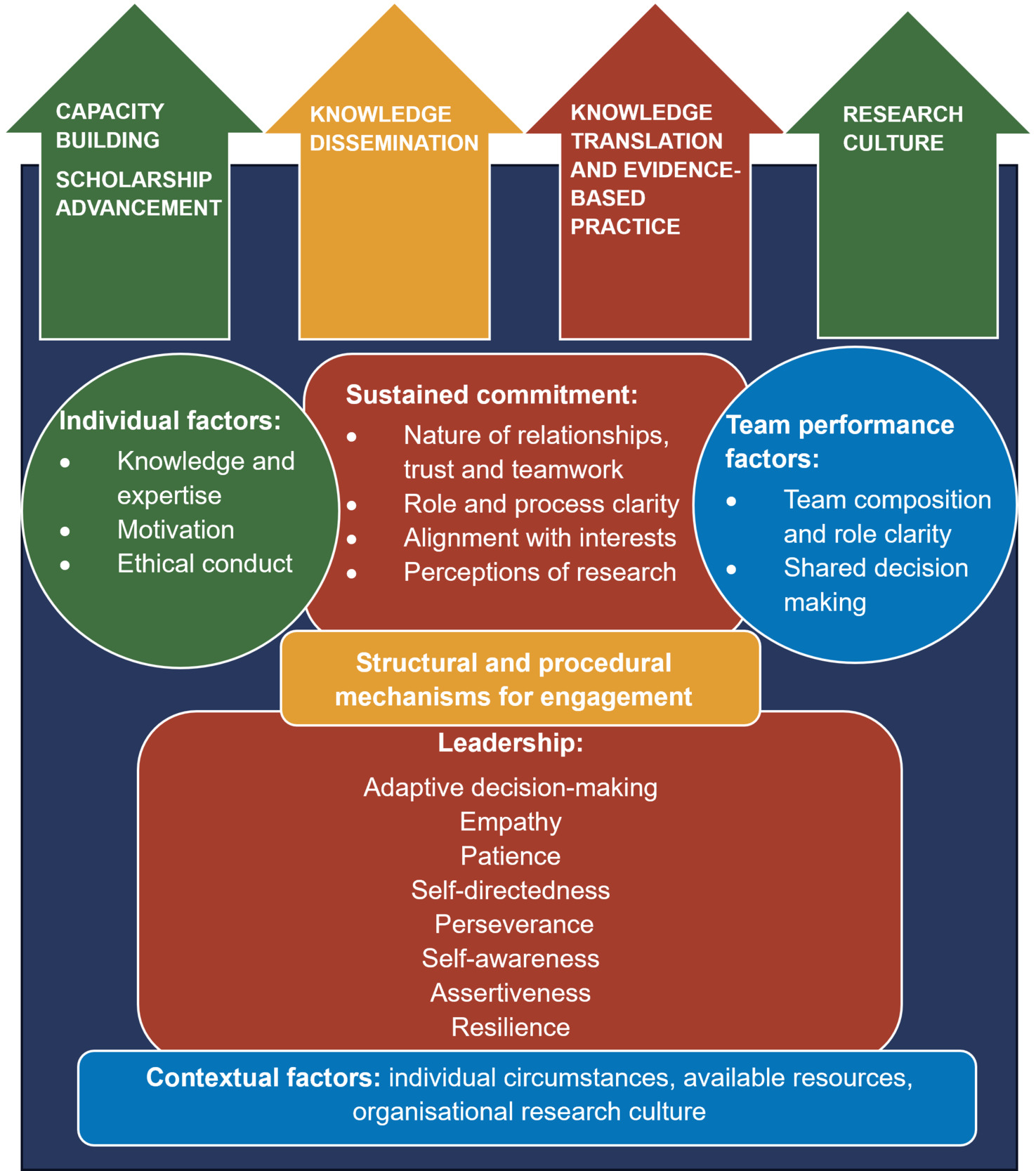
Individual-level factors that shape participation and commitment include knowledge and expertise, motivation, and ethical conducts. Personal circumstances are positioned as a contextual factor. While initial enthusiasm is often high, sustaining intrinsic motivation is essential to maintain commitment. These findings are supported by existing literature on the role of individual attributes in collaborative research, suggesting that attention to emotional and contextual factors is critical for maintaining participation over time.19 Ethical conduct is positioned as an individual factor. Often healthcare research literature traditionally focuses on procedural ethics, such as obtaining ethical approval and informed consent. The current scholarship debates show that ethical research partnerships require a broader relational ethic characterised by mutual respect, reciprocity, transparency, accountability, and benefit-sharing.20 The framework presented by the authors indicates that ethical practice operates as a mechanism for building trust, which in turn, supports sustained commitment. On the other hand, unequal participation and unmet expectations undermine commitment.
At the team level, composition and shared decision-making shape commitment. Unbalanced power dynamics undermine trust, while shared decision-making and consensus promote equitable participation. These align with research emphasising that team diversity and democratic processes support innovation and productivity in collaborative projects.21 Embedded within the team, and shaped by individual factors, structural and procedural mechanisms are required to sustain collaboration and maintain momentum. In this study, regular communication, shared platforms, clear timelines, and defined goals supported progress, while flexibility accommodated competing demands. These findings align with evidence that structured yet adaptable processes balance accountability and responsiveness in collaborative work.22
A notable feature of the framework is that knowledge dissemination and translation are treated as outcomes of collaborative research rather than post hoc activities. This reflects scholarship challenging linear models of research and positions knowledge translation as an ongoing, relational process in which stakeholders co-create, contextualise, and apply evidence throughout the research cycle.23,24 Sustained commitment, active engagement over time, and alignment of interests reflects this shift towards co-creation and knowledge mobilisation. Rather than relying solely on the dissemination of findings, the framework suggests that research uptake is enhanced when healthcare practitioners, managers, and other stakeholders participate in shaping research questions, interpreting findings, and identifying implementation strategies. This supports recent evidence that effective knowledge sharing is a two-way process involving mutual learning and relationship-building rather than the unidirectional transfer of evidence from researchers to users.24,25 The importance of contextual influences is depicted in the framework, which is consistent with recent work demonstrating that the successful translation of evidence depends on organisational culture and available resources.24,25
The debate on decolonisation of health research and knowledge co-production is particularly relevant in this framework. Scholars in the decolonisation debate criticise traditional research models for privileging academic expertise while marginalising the knowledge of practitioners, communities, and local stakeholders. These approaches often reproduce power asymmetries, resulting in research that is done on people rather than with them.26,27 Several elements of the framework respond directly to these concerns. The emphasis on shared decision-making, trust and relationships, alignment of interests, and team composition suggests a move towards more democratic and inclusive forms of knowledge production. The framework shows that valuable knowledge emerges through interactions among diverse actors, including healthcare practitioners and organisational stakeholders, rather than positioning academic researchers as sole knowledge producers.
The framework identifies shared decision-making as a critical team factor. This is consistent with decolonisation literature, which argues that addressing inequities in decision-making authority, resource allocation, authorship, and agenda-setting is essential for transforming research relationships. Decolonisation is not simply about increasing participation but about redistributing power and recognising multiple ways of knowing.26–28 Commitment is strengthened when stakeholders perceive that their knowledge, priorities, and contributions are valued. This resonates with recent scholarship on co-production and indigenous research methodologies, which emphasise reciprocity, shared ownership, and relational accountability as foundations for more equitable and socially responsive knowledge generation.27,28
Overall, the findings show that collaborative research functions as a dynamic, adaptive system in which sustained commitment is influenced by individual, team, structural and process factors. Within this system, leadership serves as the integrative mechanism that, through empathy, adaptive decision-making, patience, and advocacy, enables these factors to operate cohesively. Leaders also need to show attributes that maintain self, namely, self-directness, self-awareness, perseverance, assertiveness, and resilience.
The findings and conceptual framework highlight the human, relational, procedural, and leadership dimensions that underpin the sustainability and effectiveness of collaborative research as an enabling infrastructure within an LHS, complementing data systems and quality improvement mechanisms. Such collaboration facilitates the integration of expertise across research and multiple disciplines, supporting sustained knowledge generation, capacity development, and implementation processes aimed at strengthening healthcare systems and improving health outcomes. Within the South African context, these collaborative capabilities further enable evidence-informed practice and system-wide learning within an LHS.
Strengths and limitations of the study
A strength of this study was the use of six diverse case studies representing collaborative research initiatives involving academics, healthcare practitioners, educators, and organisational stakeholders. Although the cases were not limited to practice improvement, they illustrate how diverse research collaborations can be structured and sustained to strengthen the collaborative infrastructure underpinning continuous learning, knowledge generation, implementation, and capacity development within LHSs. The inclusion of both successful and unsuccessful collaborations enabled a nuanced exploration of factors that facilitated or constrained collaborative research and enhanced the explanatory power of the analysis by enabling comparisons across cases. Accordingly, the findings should be considered analytically transferable to similar contexts rather than statistically generalisable to all collaborative research initiatives. The retrospective nature of the reflections may have introduced recall bias, and the interpretation of events was influenced by the perspectives of the investigators involved in the collaborations.
The authors occupied dual roles as both participants in, and analysts of, the collaborations. Their extensive experience in nursing education, healthcare research, capacity building, and collaborative scholarship influenced the questions explored, the interpretation of experiences, and the development of the conceptual framework. This insider perspective provided rich contextual understanding and access to tacit knowledge that may not have been apparent to external researchers. However, it also created the potential for assumptions and biases in interpreting the cases. To mitigate this risk, the researchers engaged in structured reflection using the DEAL model, critically examined both successful and unsuccessful collaborations, and sought to identify disconfirming experiences alongside enabling factors. The resulting conceptual framework should therefore be understood as a contextually grounded interpretation of collaborative research experiences rather than a universally applicable model, while offering transferable insights for researchers seeking to establish and sustain effective research collaborations in nursing and healthcare LHSs in South Africa.
Recommendations
To sustain research collaborations in nursing education and health care, five key actions are recommended. First, establish clear structures and processes, including defined roles, shared goals, communication mechanisms, and realistic timelines to maintain accountability and momentum. Second, develop teams with complementary expertise and promote shared decision-making to ensure equitable participation, mutual respect, and collective ownership of outcomes. Third, strengthen individual research capacity while fostering motivation, trust, ethical conduct, and awareness of personal and contextual factors that influence engagement and relationships within the team. Fourth, leaders should facilitate sustained commitment by addressing individual, team, structural, and process factors, while demonstrating empathy, adaptability, advocacy, resilience, and self-awareness. Finally, embed capacity building and knowledge translation throughout the research process through mentorship, co-authorship, conference participation, and stakeholder engagement.
Conclusion
In conclusion, successful collaborative research reflects a dynamic interaction of human, relational, structural, and contextual determinants, requiring intentional design. By positioning commitment as the central mechanism and delineating multi-level determinants of effective, sustained collaboration, the proposed framework offers guidance to plan impactful research collaboration among nursing higher education, other disciplines in higher education, healthcare organisations, and healthcare practitioners. Such collaborations will enhance knowledge generation and translation to support evidence-based practice and quality health care within LHSs in South Africa, affirming the African proverb that you travel faster alone, but further together.