
Introduction
A learning health system (LHS) is a health system designed to continuously improve by integrating clinical practice, data, and research in a cyclical process of learning and improvement.1 LHSs follow a dynamic path of teaching and learning, favouring evidence-based practices. In the South African setting, an LHS may be understood as a context-responsive system that integrates routine data, experiential knowledge, and community input to continuously adapt health care delivery to local needs and constraints, particularly within decentralised district health services.2,3 Health care encounters are continuously evaluated so that service provision can be modified and improved, generating knowledge and data of strengths and limitations of current practices. This evidence-based research data aids in improving healthcare services. The use of technology and data capturing for record management and research has increased in the past decade, adding value and support for changes to improve health care globally. In addition to the digitisation aspects for the advancement in health care, social and cultural aspects4 must be considered for a holistic view in every context. The inclusion of social and cultural aspects is especially important in health care, where communication is a key aspect of service delivery. This importance is even more pronounced in the allied health field of audiology, as hearing ability is the basis of communication for the majority of the population. Accordingly, there is an increasing need for training models that support continuous learning and responsiveness within this field.
The rationale for this paper is the growing mismatch between the demand for audiology services and the limited availability of trained professionals, particularly in resource-constrained settings. Despite the increasing burden of hearing loss, challenges related to workforce shortages, limited training capacity, and uneven access to clinical learning opportunities continue to constrain service delivery.5 The rapid advancement of digital technologies and innovative educational approaches presents opportunities to strengthen training models. However, the integration of these approaches within audiology education remains underexplored. This paper highlights how LHSs, in conjunction with simulation-based education (SBE) and technological advancements, can inform more effective and sustainable approaches to audiology training.
Method
Drawing on existing literature, this conceptual paper examines the potential role of LHSs in strengthening audiology training in South Africa. Specifically, the paper: (1) outlines key challenges associated with the training and workforce deployment of audiologists in the South African context; (2) explores the application of LHS principles, particularly through digitisation and technological integration; and (3) considers the use of SBE as a strategy to enhance audiology training and education. In light of the documented shortage of audiologists in South Africa, the paper further reflects on how integrating LHS, audiology education, and SBE can contribute to addressing workforce gaps and inform more sustainable and effective healthcare solutions.
Findings
Learning health systems: key concepts and characteristics
The descriptions and core concepts underlying LHS have evolved. Earlier definitions proposed LHS as a system that continuously generates and applies evidence to guide shared decisions, integrates discovery into everyday care, and promotes innovation, quality, safety, and value.6 It was later argued that definitions of LHS were derived without including academic leaders who were directly involved in the implementation and sustainability of LHS. Maggio et al., define LHS as: “… a health care system in which clinical and care-related data are systematically integrated to catalyse discovery and implementation of new knowledge that benefits patients, the community, and the organisation through improved outcomes”.7(p215) Later definitions recognise the importance of actively involving communities, patients, and healthcare organisations within LHS. This reflects an understanding that meaningful and sustainable improvements in health care are achieved not only through data and evidence, but also through the co-production of knowledge with contributions from all stakeholders. This is reflected most concisely in the description proposed by Janse van Rensburg et al.8 who state that a learning LHS brings together data, practical experience, and ongoing reflection to support continuous improvement. Learning extends beyond numerical measures; it relies on blending ‘hard’ data with ‘soft’ or ‘warm’ intelligence, i.e., knowledge gained from lived experience and an understanding of context.8
The core LHS cycle is the simple practice of learning leading to the production of knowledge, which then improves practice. Everyday healthcare data are captured, transformed into knowledge, and applied to continually enhance care delivery. An integrated LHS is characterised by meaningful engagement with patients and their families, alongside the facilitation of dynamic and continuous learning in an environment that is transparent, safe, and equitable.
Learning health systems in developing contexts
In developing countries, including South Africa, the implementation of LHS is difficult, as insufficient financial investment from the government, inadequate infrastructure, widespread poverty, and limited documentation systems and practices restrict the efficient collection, management, and storage of healthcare data. While LHS approaches can strengthen implementation and scale-up in developing healthcare systems, their successful adoption requires investment in infrastructure, training, and human resources. This is especially important in audiology, where training opportunities across Africa remain limited. Although programmes have recently emerged in countries such as Ghana, Uganda, and Kenya, they are offered by limited institutions.9 A severe shortage of audiologists, fewer than one per million people,10 further restricts access to care. This gap reflects broader challenges, including limited funding and training capacity.
In South Africa, strong government support is key to translating research into practice and improving health outcomes locally and regionally. South Africa’s relatively established audiology training system provides a useful context, although it is acknowledged that more effort is needed to enhance transformation and ensure widespread access to services.11 Similar challenges will be more pronounced in other developing countries.
Overview and challenges with audiology training in South Africa
Audiology training varies significantly across countries. In the United Kingdom and Northern Ireland, training occurs at multiple levels: audiometrists perform basic testing and are responsible for dispensing and fitting hearing aids; healthcare science practitioners provide diagnostic and treatment services, while clinical scientists manage complex cases.12 In contrast, South Africa offers training for audiometrists and hearing aid acousticians to conduct adult testing and hearing aid fittings, while audiologists are comprehensively trained to perform diagnostic assessments, treatment, and management of complex cases.13 While this extensive training results in competent, well-prepared audiologists who can provide comprehensive services to patients, it also results in audiologists who are more likely to emigrate to better-resourced countries with more employment opportunities. Globalisation, through brain drain, appears to exacerbate disparities by making human capital even scarcer in regions where it is already limited, while concentrating it further in areas where it is abundant, thus deepening inequality across nations.14
While a core premise of global health is that many developing countries lack the resources or capacity to fully address their own health challenges, Kwete et al.,15 argue that this should be reconsidered from a postcolonial and neo-colonial lens. Considering the points made regarding the economic and human capital that is available in developed countries,15 the contribution that developing countries can make to developed countries in terms of human resources for hearing health care should be acknowledged.
The human resource aspect of health care, from the globalisation and fiscal resources perspectives, is complicated. A global survey revealed that 86% of countries reported an insufficient number of audiologists to meet community needs,16 indicating that this shortage of hearing healthcare professionals is a challenge in developed as well as developing countries. While the authors attribute this shortage primarily to systemic factors such as the absence of audiology education programmes (as in many African and Asian countries), limited government support and inadequate employment opportunities, additional contributing factors include low awareness of the profession and restricted student intake due to limited clinical placement availability. Even in a developed country such as Australia, efforts to increase the number of audiology graduates are challenged by the limited capacity for clinical training.17 A study on the sustainability of allied health clinical placement capacity in Australia found that addressing this challenge requires ongoing collection and reporting of outcome data, consistent support for dedicated allied health clinical education roles, strong statewide leadership and profession-specific governance, as well as management commitment to clinical placement provision.18 While these recommendations appear relevant and applicable to South Africa, the funding and resources necessary to implement them would likely be unattainable. Planning and future resource allocation for this would mean a delay in data gathering, data analysis, and implementation of recommendations.
South Africa urgently needs more accessible solutions, as audiology services remain critically insufficient. The practitioner-to-population ratio is only 0.57 per 10 000, with notable provincial disparities being higher in Gauteng (0.97), KwaZulu-Natal (0.53), and the Western Cape (1.03), and much lower in the Eastern Cape (0.19), North West (0.15), and Northern Cape (0.35).5 The authors foresee a gap of 2 800 professionals by the year 2030, clearly pointing to a need for healthcare planning, funding of training of hearing healthcare professionals and appropriate clinical training and clinical experience prior to independent practice.
Bernstein et al., report concerns that: “In the absence of a framework to discuss and evaluate innovation, opportunities and resources may be squandered in developing products and services that are minor innovations, whereas only radical or disruptive innovation can solve pressing needs for hearing health care”.19(p376) They describe innovations that are transforming audiology, particularly through the influence of the Internet and mobile technologies. They use a taxonomy by Edison et al. to classify innovations by impact: incremental, market breakthrough, technological breakthrough, and disruptive, and by type: product, process, market, and organisational.20 The discussion overlooks a key issue: the impact of innovation on audiology training, particularly its economic and practical implications. It largely ignores how technologies, such as tele-audiology, could disrupt education and service delivery, with little attention to how audiologists are trained to use these tools, especially in low-resource settings.
While the innovations described by Bernstein et al.,19 include using low-cost smartphones and calibrated headphones for hearing testing, over-the-counter hearing aids to improve accessibility, and a national smartphone hearing test, there is a lack of focus on how applicable these tools are to developing countries and whether this is a sustainable means of improving audiology reach and access to services. This is especially important to consider in the context of paediatric audiology, as many of the tools and technologies focus on the adult population, with no attention to paediatric audiology services.
Even with significant technological progress, millions worldwide have limited access to digital health tools due to persistent connectivity gaps, affordability constraints, low health and digital literacy, and entrenched cultural and gender disparities that disproportionately affect women and rural populations.21 In this context, the distribution of devices, technologies, and related products must be critically assessed through the lens of global health practices, many of which are rooted in colonial legacies. Kwete et al.,15 state that colonial legacies include anything that continues to perpetuate the inferior positioning of the communities and systems receiving global health interventions. Thus, considering technological advancements within the context of innovations that are commercially produced, even if they are provided free of charge to developing nations, there is still a perpetuation of colonial ideologies and a lack of consideration of the cultural and linguistic contexts and beliefs of developing nations.
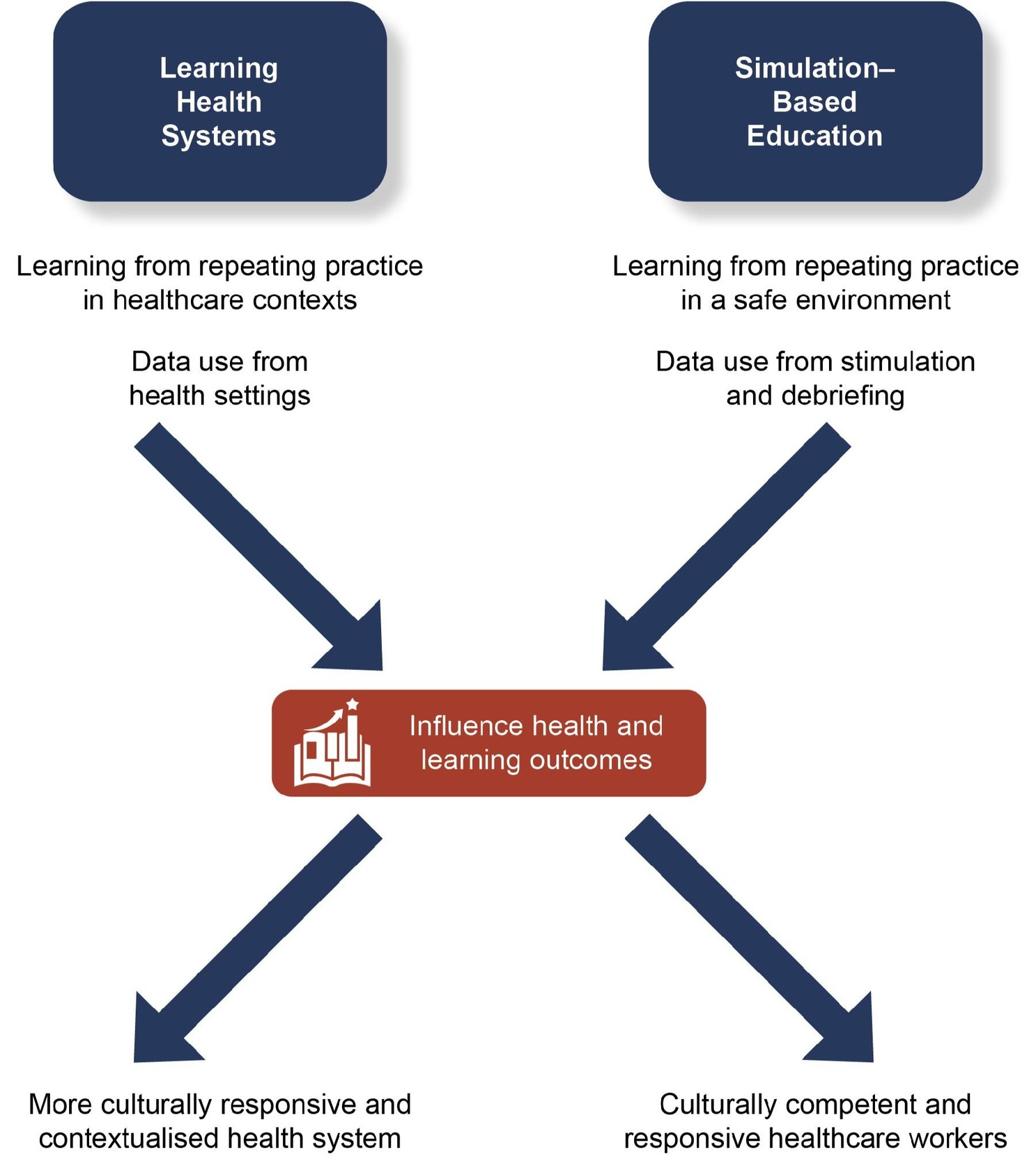
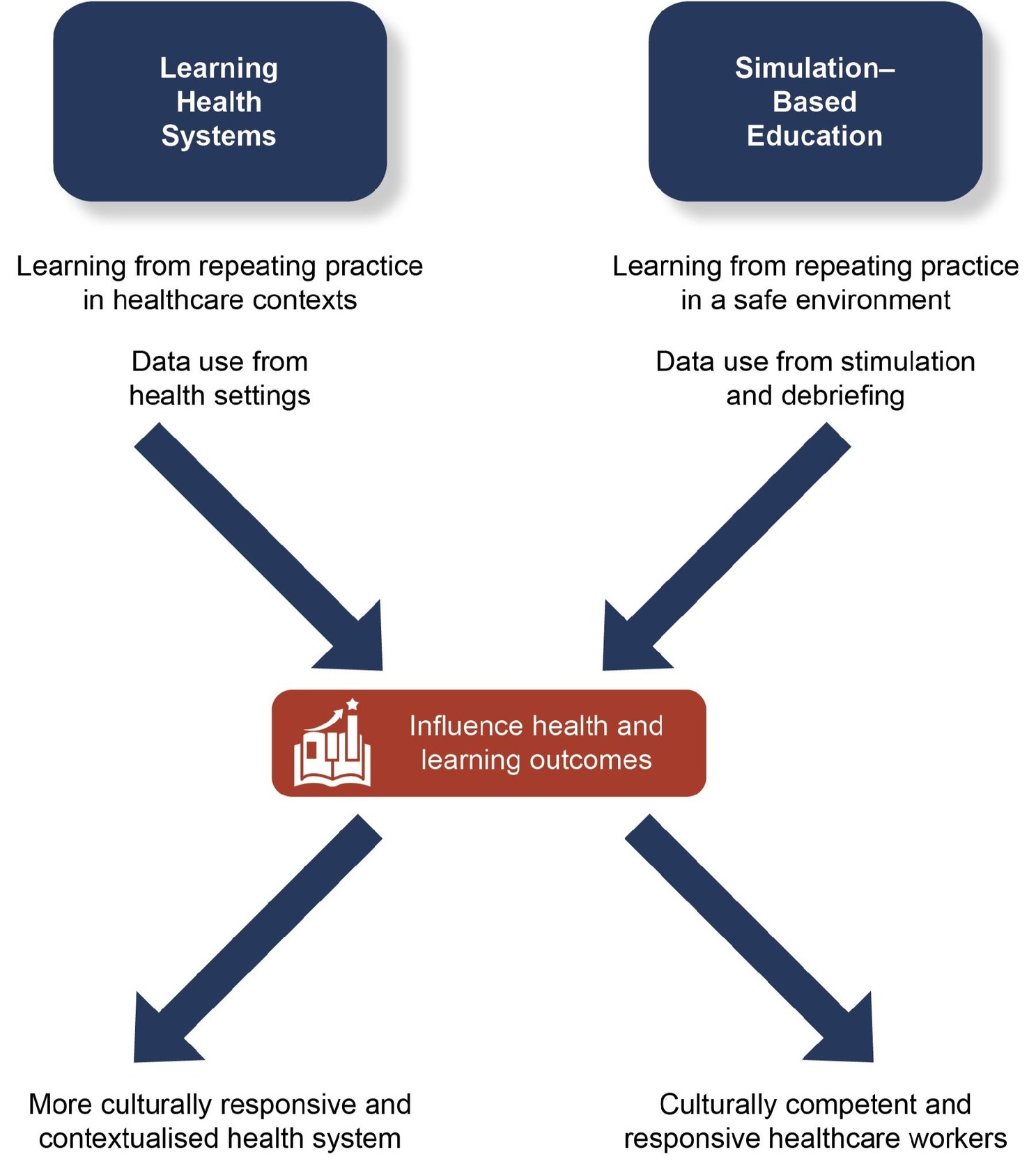
Technologies such as AI, telehealth, and data analytics can improve service delivery but must be adapted to local infrastructure, culture and training constraints.22 Simulation shows strong potential to address these challenges, including limited clinical placement opportunities. Moreover, its use in audiology training has the potential to offer structured, scalable, and context-responsive training experiences for students and clinicians. The ways in which SBE and LHS intersect are indicated in Figure 1.
Use of simulation in learning health systems and audiology
Simulation in health care is defined as a technique, rather than a technology, used to replace or enhance real clinical experiences through guided activities that replicate essential aspects of real-world practice.23 High-fidelity simulation typically incorporates technologically advanced tools such as part-task trainers, manikins, and virtual or augmented reality platforms, whereas low-fidelity approaches rely on standardised patients, role-play, and case-based scenarios. Both these technology levels can be incorporated into allied-health simulation-based education. For example, low-fidelity simulation activities can include communication skills training for case history and feedback using standardised patients, while high-fidelity is required for part-task training for hearing testing and obtaining and analysing responses in electrophysiology. Regardless of the fidelity level, effective simulation requires careful design grounded in an appropriate adult learning theory. In the context of developing countries, humanistic learning theory offers a particularly relevant framework, as it acknowledges learners’ subjective experiences and supports personal growth, autonomy, and self-directed development. By positioning learners as active, self-motivated agents with an inherent capacity for growth and self-actualisation, this approach also allows for challenging and disrupting colonial legacies that are part of traditional healthcare education systems. In the South African context, humanistic learning theory principles closely parallel LHS approaches, which emphasise continuous reflection, experiential engagement, and continuous improvement across all levels of the health system.24
Use of simulation in learning health systems and audiology in South Africa
Simulation-based education in audiology promotes active learning, self-awareness, and technical skill development in a supportive environment. By valuing diverse experiences and fostering learner autonomy, it offers a practical approach for resource-limited settings, reducing reliance on support from industrialised countries.
Discussion
The intersection of SBE and LHS, viewed from a humanistic learning theory perspective, has both benefits and limitations.
Benefits of simulation-based education in audiology training
Promotes experiential learning
One of the fundamental benefits of SBE is its focus on experiential learning, which is central to humanistic pedagogy. Audiology students can practice diagnostic and therapeutic techniques in simulated scenarios without the risk of harm to actual patients. This type of learning encourages active participation, personal reflection, and the application of knowledge in real-world contexts. Kolb’s experiential learning theory states that knowledge is constructed through experience,25 and simulation provides the opportunity for students to gain experience in testing and refining their clinical skills in a safe, controlled environment. In audiology training, this can enhance both technical knowledge and interpersonal skills such as empathy and communication with patients. In rural settings of developing countries, SBE activities can include role-play and case studies that are specific to the local context. This repetitive,
experience-based cycle aligns with the LHS model where learning is through repeated practice, data use, and refinement in real-world settings.9
Fosters self-directed learning
Humanistic learning theory directs that learners should take responsibility for their own learning. SBE is an effective tool for self-directed learning, as theoretically, students can engage with scenarios at their own pace and see the effect of their responses in various situations. Audiology students can explore different audiological cases, practice diagnostic assessments and implement treatment plans. Self-directed learning aligns with the humanistic focus on autonomy and individualised growth, allowing students to reflect on their strengths and areas for improvement.26 Similarly, LHS highlights the importance of autonomy and reflection among clinicians, using data and experiential learning to guide ongoing improvement.9
Encourages personal growth and emotional development
Humanistic learning emphasises the development of the whole person in the domains of emotional, cognitive, and social growth.27 Audiology students can experience various patient scenarios that challenge them to manage different emotional responses and deal with various ethical dilemmas. Simulations through case studies and role play involving difficult patients or challenging diagnostic cases allow learners to practice empathy, compassion, and problem-solving in emotionally tense situations. Simulation has been shown to help students develop clinical knowledge as well as skills.28 Through reflective practice, students can develop an understanding of their own emotional responses and improve their ability to appropriately interact with future patients. South African LHS programmes focus on emotional awareness, collaboration, and reflection as key components of improving both clinical work and system responsiveness.29
Safe environment for learning from mistakes
One of the key strengths of SBE is that it allows learners to make mistakes in a non-threatening environment. This aligns with the humanistic principle of unconditional positive regard, where learners are supported and accepted regardless of errors or performance. Audiology students can practice various procedures, such as hearing assessments and diagnostic tests, without the fear of causing harm to patients. Difficulties and errors in simulation activities can be viewed as valuable learning opportunities, helping students to gain confidence in their clinical skills and decision-making abilities.1
Within LHS, there is an understanding of single-, double-, and triple-loop learning, emphasising that deeper forms of learning can transform system practices and underlying assumptions.8 These learning loops reflect increasingly sophisticated responses to errors and performance gaps, ranging from correcting immediate problems to reconsidering underlying assumptions and system values. This framework is a key foundation of simulation-based learning, and simulation activities can be designed to reflect each level of the learning loop. An example of how simulation can be applied to audiology training is provided in Table 1.
Limitations of simulation-based education in audiology training
Overemphasis on technical skills
Simulation-based education could be criticised for the emphasis on developing technical and diagnostic skills, through the use of manikins and simulated equipment. The holistic aspects of audiology practice, such as patient-centred care, cultural competence, and ethical decision-making, are more difficult to design realistic and effective simulations for and thus may not provide the same depth of learning as real-world experiences would. Humanistic learning emphasises that learning must engage the whole person, including ethical, social, and emotional development. Without careful simulation planning, design and integration of reflection, SBE may not fully facilitate these dimensions of learning.27 Including all these aspects requires substantial funding and time, as resources are needed for infrastructure development, personnel training, programme implementation, and ongoing evaluation. Similarly, South African LHS research notes that system learning risks becoming overly technical unless relational, cultural, and contextual dimensions are purposefully integrated.7
Potential for misleading confidence
While a major positive of SBE is the development of confidence and allowing a feeling of personal growth and development, this is also a major limitation. Repeated success in simulated environments might increase confidence without being realistic about the complexities of real-world practice. This is especially true if the simulation design is not carefully planned. Students might feel overconfident after completing numerous simulations, not realising that real clinical situations often present complex challenges. Simulation-based education should therefore be supported by real-world clinical experiences that offer a more accurate and nuanced understanding of patient care.
Learning health system theories emphasise learning in authentic practice environments to ensure competency and realistic expectations.30
Lessons learnt
The application of SBE in audiology training through the lens of humanistic learning theory has numerous humanistic benefits. This aligns with the epistemology of experiential learning, self-directed growth, and emotional development. However, there are significant challenges and limitations, including resource constraints, a possibility of not adhering to the realities related to the complexity of the humanistic aspect, and the limitations of technological fidelity.
South African LHS studies highlight that investment in infrastructure, reflection, and integrated clinical environments is essential for meaningful learning and system strengthening.8 The district health system (DHS) already has the seeds for learning, including locally collected (hard) data and lived experience (warm data), as well as knowledge of context and local realities (soft data), proximity to the community, and a wide range of relationships.8 Processes that bring these factors together can generate new ways of functioning to better meet community health needs, while also supporting new and transformative ways of learning.1
The implementation of SBE in the training of audiologists represents a new way of learning that addresses the challenge of limited clinical training placement opportunities. At the same time, it acknowledges the strengths of communities and lived experiences in the design of the simulation. This allows for the adaptation of the simulation experiences to suit the local context, providing students with opportunities to gain experience with conditions they are likely to come across when practising. In addition, the recognition of human capital, traditional and local knowledge, and lives is a clear valuing of African life.
Successful implementation of LHS is dependent on strong, sustained relationships, shared ownership of learning processes, and programmes that support reflection and collaboration.30 Collaboration between communities, national healthcare directors, and universities will pave the way for discussions on how this model can be effectively implemented across healthcare training. This represents a significant step towards addressing the colonial legacies of learning and developing Afrocentric material and resources that are responsive to African health needs.
Recommendations
In South Africa, the levels of healthcare service provision vary within the nine provinces. The DHS is vital within the structures because of its direct relationship with the community, and forms the foundation of South Africa’s national healthcare system.31 The decentralised nature of the DHS allows for contextually responsive health care delivery. This community-oriented approach aligns with the principles of primary health care, which emphasise accessibility, equity, and community participation as core components of effective health systems.32 Community participation within SBE can extend to the training of community members as standardised patients. This approach will serve the dual purpose of supporting the workforce required for SBE activities while simultaneously facilitating community education on specific pathologies, illnesses, and presenting complaints.
Both downstream healthcare service delivery and upstream social determinants of health can be addressed through the DHS.1 The DHS provides a critical platform for integrating clinical services with public health interventions, thus enabling the management of both communicable and non-communicable diseases.
A strong foundation at the DHS level can ensure that data are collected, captured, and collated at ground level. Strengthening health information systems within the DHS enhances evidence-based decision-making and supports continuous quality improvement initiatives.33 Reliable data systems also enable monitoring and evaluation of health programmes. In this context, the development of LHSs is particularly important as they rely on real-time data to inform practice, policy, and research in an iterative cycle of improvement.34 In audiology, embedding SBE within data-driven LHSs at the DHS level facilitates the continuous refinement of clinical training, ensuring that students develop contextually relevant competencies that are aligned with real-world population hearing health needs.
Training healthcare workers should be the initial step in the process of LHS, with great rewards for the service provider and healthcare clients. Undergraduate training programmes in the country can support the implementation of the initial phases of training, after which the DHS can build and reinforce this training. Integrating LHS concepts, community-based education, and interprofessional learning into undergraduate curricula prepares graduates for practice in resource-constrained and dynamic health system environments.35 Framing this training within the context of SBE enables student exposure to a diverse and contextually relevant caseload. Students are provided with opportunities for holistic training without compromising patient safety.
Practical implementation of SBE within an LHS framework will involve integrating SBE across progressive years of training. For example, in the initial years of training, students could first be exposed to contextually relevant case studies and virtual patient scenarios to develop clinical reasoning and decision-making skills for common primary health care presentations, such as otitis media and presbycusis. As competence develops, high-fidelity simulators, such as paediatric manikins or electrophysiology trainers, could be used to practise procedures including auditory brainstem response testing and newborn hearing screening in a safe environment. Standardised patients recruited from local communities would facilitate training in counselling, culturally responsive communication, and delivery of difficult diagnoses to patients and caregivers. Data generated through these simulation activities, including learner performance, common errors, and identified service gaps, can then be fed back into district health services and educational programmes, creating a continuous learning cycle consistent with LHS principles.
Conclusion
This paper proposes the development of a coherent, integrated model for simulation-based audiology education. By situating simulation within the pedagogical approach of humanistic learning theory the model demonstrates how simulation can be strategically embedded across training programmes to enhance clinical preparedness and competence. It offers a pathway for reimagining audiology curricula in ways that are responsive to local realities, resource constraints, and diverse patient populations. This allows the model to contribute towards decolonial efforts in health professions education by foregrounding contextual relevance and inclusivity. Further research towards developing practical curricula and case studies, and implementation of this model provides a foundation for interdisciplinary collaboration, and sustainable curriculum transformation.