
Introduction
This paper describes the initial steps taken to establish a learning health system (LHS) in three sub-districts of the Western Cape. It discusses the establishment of a sustainable culture of reflection and learning within the health system. The paper is presented as a case study involving stakeholders and communities, with the aim of sharing emerging issues that may be helpful to others in similar situations.
While this project was externally funded, the sustainability of creating a culture of learning alongside service delivery is the focus of this paper. The Healthy Futures South Africa (HFSA) project, through the University of Cape Town (UCT), serves as a single case study with its own strengths and weaknesses in a particular context of time and place, but with sufficient diversity in the three geographic sites to derive interesting analyses from the internal comparisons of the processes in the three sub-districts to inform other health districts in similar contexts.
Learning health systems
Learning health systems iteratively use evidence from research, service data, and experience from routine practice and systematically convert these to knowledge that aims to improve health system performance and individual and population health outcomes. Most studies on LHSs focus on learning from implementing a particular clinical programme, system, or platform with very few focusing on stakeholder perspectives,1 suggesting that there is limited LHS evidence on the social and partnership processes essential to equitable learning with stakeholders and communities. Challenges that have been documented2 include power inequities between communities, health workers, and policymakers; managing participants’ expectations; and sustainability.3 Furthermore, there is limited evidence on how to measure the impact of collaborative learning that is focused on equity and social determinants of health beyond clinical care.1
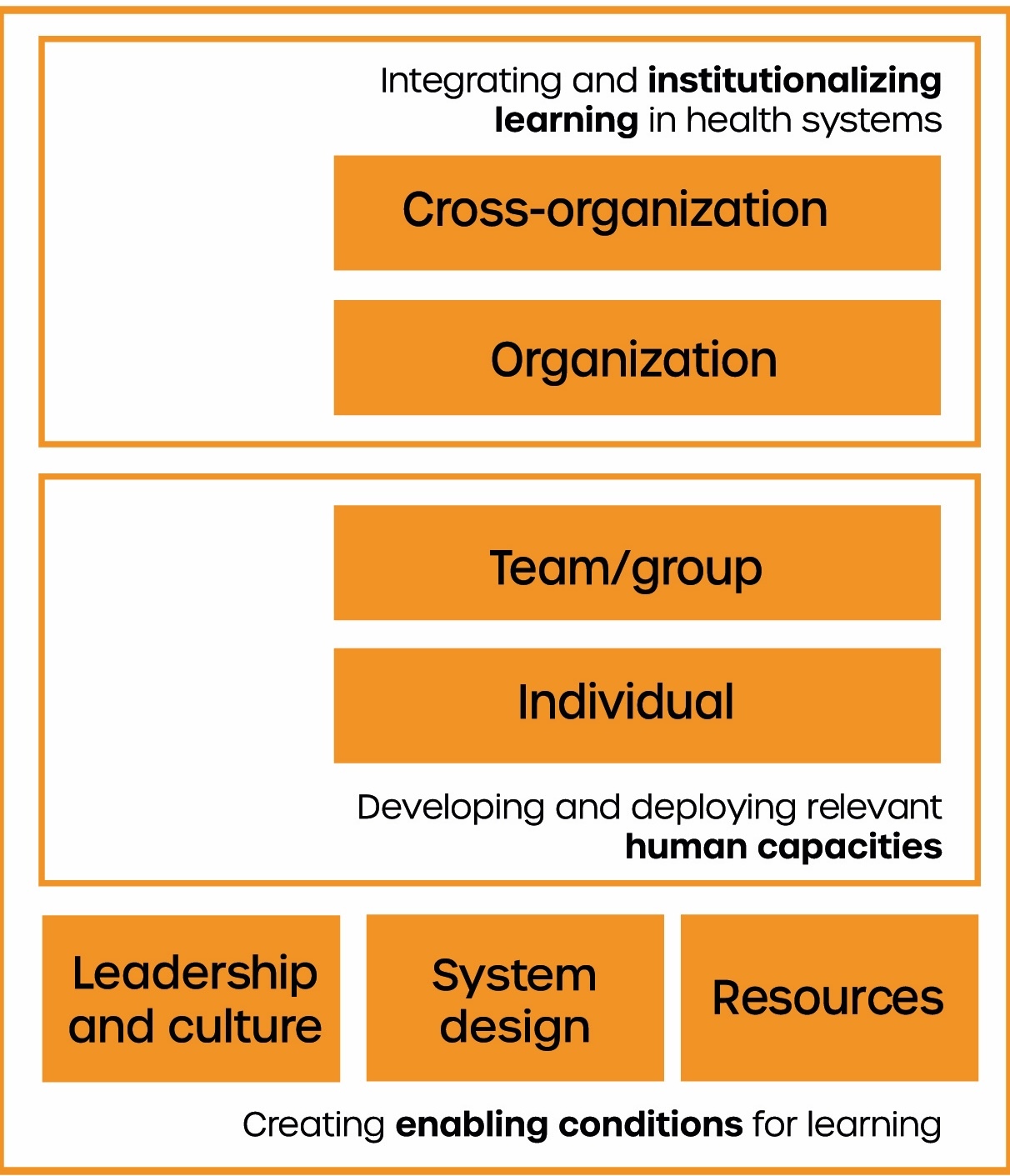
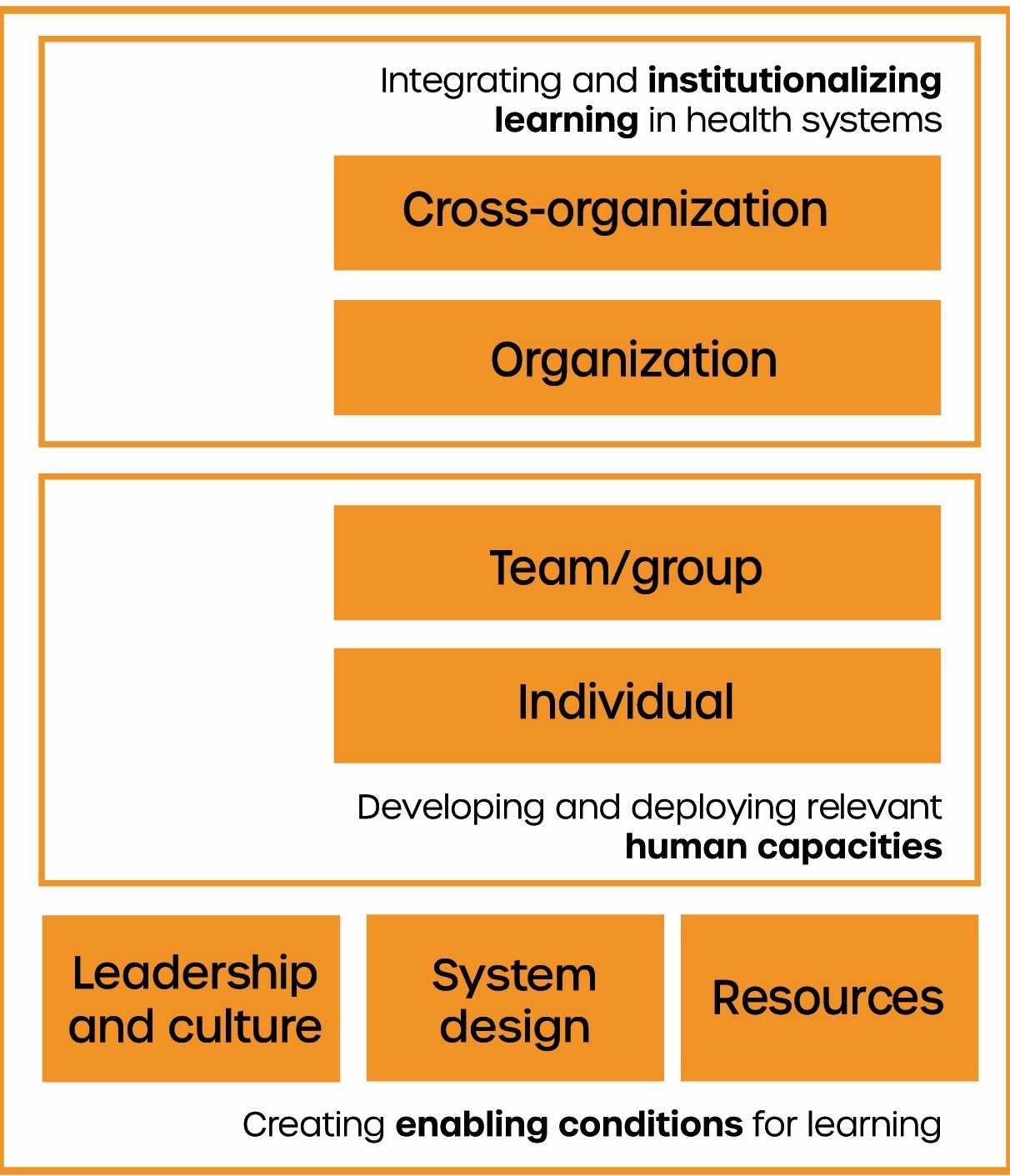
To address the HFSA goals and the knowledge gap, a definition of an LHS that was not limited to health services but included the social and contextual determinants of health was adopted. The following description is most closely aligned with the approach adopted: “Learning in health systems can … be said to occur by making the link between past actions, the effectiveness of those actions, and future actions”.4 The concepts of single-loop learning (adaptive learning),5 double-loop learning (generative learning),5 and triple-loop learning (meta-learning)6 were adopted. The LHS design followed the model of implementation of LHS endorsed by the World Health Organization (WHO),7 which describes three essential pillars: enabling conditions, human capacities, and institutionalising learning (Figure 1).
Healthy Futures South Africa
A partnership between UCT and the Western Cape Government: Department of Health and Wellness (WCDHW) received a grant from the Mastercard Foundation (MCF) under the Africa Health Collaborative (AHC)8 in 2023 to strengthen primary health care by empowering and preparing young people for employment and health entrepreneurship in three sub-districts over eight years.
Three sites in the Western Cape, representative of many communities in South Africa and Africa with low socio-economic development and high youth unemployment levels, were identified for the project: one urban sub-district (Klipfontein) and two rural sub-districts (Saldanha Bay and Knysna-Bitou), totalling approximately 720 000 people. Sub-districts in South Africa are ideally sized to function as learning systems, since they are locally accessible and usually include at least one district hospital, some community health centres and several clinics, serving populations of up to 500 000. Some also include secondary or regional hospitals. By contrast, health districts that often serve populations of 1.2 million, would make learning systems impersonal and unwieldy.
In addition to the three ‘pillars’ of the project, which deal with employment, entrepreneurship, and ecosystems, a fourth pillar of collaborative learning and networking was proposed and developed. The fourth pillar includes monitoring, evaluation, learning and adaptation, which gave rise to the learning project reported here.
The initial HFSA team created a foundational theory of change that elaborated on the organisational pillars of the proposal and articulated a common vision: “Improved health, well-being and livelihoods of community members in the three sub-districts in the Western Cape through improved primary health care service delivery and strengthened capacity and opportunities especially among women and youth” (unpublished workshop report, 2024).
This paper describes how HFSA designed and adapted learning circles (LCs) and learning forums (LFs) as early learning mechanisms and identifies lessons for institutionalising equitable learning in primary health care systems.
Method
Alongside the project implementation, a participatory action research (PAR) project was developed, which serves as the basis for the data presented in this paper. The interim aim of the research project was to learn from an analysis of the key issues and emergent processes in the HFSA project and to present a framework for ongoing documentation. The stated objectives were:
-
to convene a collaborative learning circle for ongoing reflection on HFSA;
-
to document activities, key issues and research questions emerging from HFSA;
-
to develop a framework for ongoing reflection and documentation of the process.
Practical knowledge about HFSA was generated through active collaboration with HFSA programme implementation committee (PIC) members (health service managers and stakeholders) as the study participants to inform project work in the implementation sites. A few months into the project, participants revised the aims and objectives of the project, as is expected in PAR, to focus on what and how to learn.
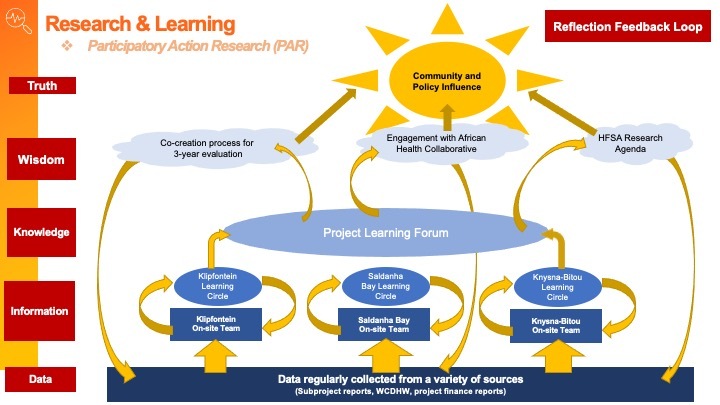
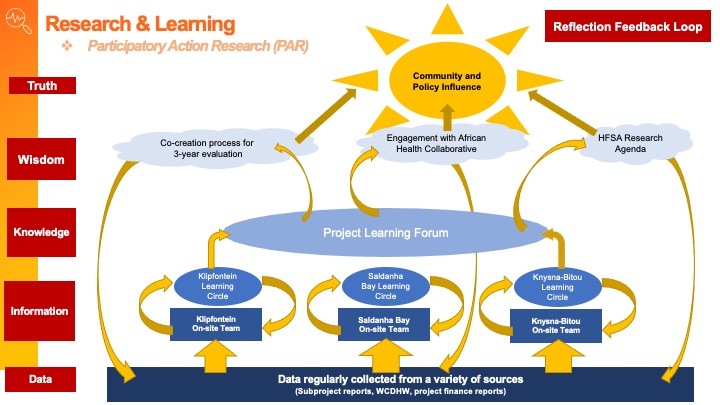
This participative process resulted in a plan for a series of reflective activities at two levels within HFSA: quarterly LCs at the site level, and six-monthly LFs at the project level with representatives from all three sites and the central team. The LC meetings at each site collate data from a variety of sources at the local level, feeding the information generated into the LF events across the whole project. This learning process is further disseminated at an annual convening of all partners within the AHC. This structure institutionalises learning, as described in the WHO model of LHS implementation.7 In this collaboration, an LC is defined as a reflective space within the HFSA project where team members can identify key issues, engage critically with conceptual issues around the project, facilitate sharing across sites, including internationally, and identify emerging research questions. Expected outputs of the LFs are research priorities, ideas for monitoring and evaluation, and concepts to share with the wider AHC. Ultimately, these are expected to influence both community practices and policy (Figure 2).
Twenty-one initial individual interviews with members of the PIC serving as key informants were conducted by a trained qualitative researcher, recorded and analysed. Since the research team was drawn from the PIC, an independent researcher was contracted to conduct the interviews and perform the initial inductive coding. Care was taken to ensure reflexivity with regard to the researchers’ positionality through frequent occasions for ‘triple-loop learning’.6 Records and minutes of all LC and LF meetings held between November 2024 and December 2025 were reviewed. Critical thematic analysis of the interview transcripts and document reviews was conducted by the research team.
Ethics
Ethics approval was obtained from the University of Cape Town Human Research Ethics Committee (ref. 422/2024). Informed consent was obtained from all participants, and those with designated roles within the organisation agreed to be identified by their positions as co-authors of this paper. Community participants in the LCs were reimbursed for transport expenses when requested. The project funder did not directly influence the research questions, programme design, interpretation, reporting, or approval of the manuscript.
Initial interviews
Individual interviews took place between July and September 2024, following the first six months of project implementation. Key events that occurred during this time included the establishment of governance structures such as steering, finance, and project implementation committees; development of the project’s theory of change through a series of collaborative workshops; hosting the first international convening of the broader AHC network; and implementation roll-out of various project activities across the three sites. This provided participants with substantial opportunities for reflection regarding project activities across various levels of HFSA implementation. Many participants also played active roles in the funding application and project design stages, thereby engaging even more deeply in the project’s evolution.
Participants included representatives from the WCDHW (4); UCT academic leadership (3); and academic staff from the UCT Faculty of Health Sciences (8), the UCT School of Education (2) and the UCT School of Business (2); and HFSA project management staff (2). Participants were purposively selected for their depth of engagement and range of perspectives on HFSA.
Findings
Initial design and expectations: what went well
Strong leadership and a clear vision were central to establishing the project and achieving early success. Respondents appreciated that the HFSA leadership was explicit in its communication with funders, partners, and community members about the project’s potential for systems-level innovation and, within that context, the need for experimentation and the risk of failure:
The attitude and approach around how do we learn from our mistakes and do better together through the mistakes that we’re making is very healthy when it comes to development and multi-level collaboration work … We are being respected for being experts in [our] field and for being able to offer expertise in particular ways. I don’t feel at any point this has been a prescriptive model, but rather an inquiry model of how do we do this best together and learn as we go. (HFSA Project Lead)
The innovative approach also helped to cultivate enthusiasm and buy-in for the project. Project members were empowered by the project’s philosophy and valued its alignment with community-oriented primary care (COPC) and public health principles, which are priority initiatives for the local health system: “It’s a very encouraging project … We need more good news stories and this is potentially not just one, but several good news stories that we can put out there. This is like a breath of fresh air”, (WCDHW Manager).
Another notable strength is the project’s creation of an enabling environment for co-creation. The project design was intentionally built on pre-existing collaborative partnerships between the university and health system across the three sites. This allowed the project to function as an opportunity for members to deepen and extend collaborations: “Many of us also bring long-standing relationships with partners. For example, when I meet with DoH (Department of Health) managers, I’m not introducing myself – we’ve often known each other for ten years or more. There’s trust, mutual respect, and a shared history of working through difficult situations together”, (HFSA Site Lead).
Developing internal systems for governance and programme management was another important first step, especially for a project of this size and complexity. Participants viewed the early integration of reflection and learning processes into these systems as a valuable and effective practice:
Strengths would be the [learning activities] bringing us all together to think, conceptualise at a higher level, collaborate in our thinking around objectives … around everything that has helped build this incredibly beautiful complex, multi-levelled and multi-layered structure. As we build it, it becomes larger and more complex and therefore more essential that we continue to come together to think. (HFSA Project Lead)
Participants emphasised the need to be intentional about how reflections are implemented and how lessons are documented, shared, and integrated into project enhancements to ensure outputs are relevant, comprehensive, accessible, and applied.
Early implementation and interview reflections: what became clearer
Activities such as the theory of change workshop series enabled a deeper understanding of the project through in-depth, intersectoral co-creation: “The purposeful approaches of collective sensemaking are important to having shared understandings that provide the platform for action … that importantly requires certain ways of organising, certain styles of leadership. I think those are the things that are going well”, (UCT Faculty of Health Sciences member).
Defining the roles of the various actors within the project was an essential development in the early stages. This contributed to a clearer division of tasks, more effective implementation, and greater ownership of programming by the project implementers: “We [academics] are not the implementers, we must allow the province and our partners to implement and we must set things up with them, we must evaluate, we must research, we must document, we must make sense and analyse the connections. That’s what we must do”, (Principal Investigator).
Recognising the diversity of the three implementation sites and the need to allow space for their differences was another significant lesson in early implementation. The sites span both rural and urban contexts, and participants acknowledged the need to engage intentionally with these differences rather than prescribing a single approach for every site:
We don’t want to go into any community and engage on our terms because we have the funding and that’s our source of power. And we come from these massive international institutions … I certainly don’t want to be responsible for that type of colonialism. I prefer engagements with communities to be sincere and humble, and if it means that we step away from some of the objectives that we’ve imagined and co-create a new set of objectives that would be to the communities’ advantage, then I think we need to seriously consider doing that. (HFSA Site Lead)
Initial analysis: challenges and responses
A primary challenge during the initial stages of implementation was bureaucratic delay in the hiring of staff. To ensure sustainability, many positions were dual appointments, requiring both university and government human resources processes and further compounding bureaucratic complexity: “You’ve got to keep the pace reasonable and you don’t want to lose impetus. Otherwise, people do find other things to do and they move on”, (WCDHW Manager).
Concerns about loss of project support or momentum also arose from the numerous competing priorities faced by project members, most of whom are senior academics and high-level managers in the WCDHW with extensive workloads. This limited capacity was compounded by another notable challenge - the project’s complexity and its impact on project ownership: “The overall guiding vision of the project and the ultimate goal towards which we’re working is quite a big overarching goal. You need something that can address multi-sectoral work and how it all comes together because it’s not just healthcare”, (UCT Faculty of Health Sciences member).
A response to this complexity was in-depth engagement in cross-sectoral work; one participant highlighted their experience as a representative for the health entrepreneurship pillar as a key learning process for themselves and others: “Seeing activities in practice made a big difference. Attending Schools Development Unit sessions or the entrepreneurship bootcamp helped me really understand the professional identities and contributions of different partners. It’s very different from just hearing about the work in meetings”, (HFSA Site Lead).
Finally, there is a recognition that while complexity may be a challenge, it is also something to be embraced. HFSA grapples with complex questions in complex contexts, so the richness of lessons from this process may be one of the project’s most valuable outcomes: “You’re talking about really complex social issues … You have to meet complexity with complexity and our job as academics is going to have to be trying to simplify … we are in this to make sense of things. We are in this to help connect the dots”, (Principal Investigator). Another participant added: “We’re not looking for space to fail as much as we are looking for space to learn over time … I foreground the learning … that way if we define the project’s success as being learning, then we’re never going to fail”, (HFSA Site Lead).
Evolution of learning circles and learning forums
Building on the interview findings, these results describe how learning was enacted through LCs and LFs, and how these spaces functioned as mechanisms within a developing LHS. Reports, minutes, and participant reflections from November 2024 to December 2025 were analysed to examine how participation, purpose, organisation, and governance of learning evolved, and how learning informed programme adaptation. Appendix 1a summarises the attendance, duration, focus and outputs of the 10 LCs, while Appendix 1b summarises the two LFs. The findings are presented as cross-cutting themes, and Appendix 1c shows how learning entered, moved through, and influenced the system.
Learning trajectories across the system
Participation and representation evolved: who learns and who learns with whom
Early LCs were primarily attended by HFSA implementing partners and health system actors, resulting in learning shaped by institutional and service-delivery perspectives. In addition, early reflections highlighted challenges in achieving meaningful youth participation, despite it being a programme priority. Over time, participation broadened. Later LCs included more consistent representation from community stakeholders, youth representatives, ward councillors, and non-health actors. In Knysna-Bitou, the deliberate use of accessible community venues linked to community-oriented primary care services supported broader engagement and aimed to reduce barriers to community participation. Youth participation increased through learner council representatives and youth-linked organisations. However, young people not in education, employment, or training (NEET) remained largely absent across sites, although non-governmental organisations (NGOs) supporting this group have become part of the learning platforms. Furthermore, HFSA has deliberately employed NEETs, where possible, to include their voices in programming and implementation.
Information sharing versus reflective learning versus action: clarifying the purpose of learning
A recurring tension concerned the functioning of LCs. Early sessions prioritised information sharing about activities across HFSA pillars. While valued within a complex, multi-partner programme, this constrained the time available for reflection and collective sensemaking, particularly in shorter and virtual sessions.
The role of data is underdeveloped in the project so far, as systems for appropriate data collection and management are fragmented and limited. Despite the intention to use data as the driver of learning, experience to date reflects learning that is social and relational rather than primarily data-driven (Appendix 1c). This relational emphasis may be more appropriate for COPC, where participation is key.
Through iterative reflection, participants increasingly differentiated routine information sharing from reflective learning. There was growing agreement that LCs were most effective when they created protected space for reflection rather than serving as update forums. This led to an emerging consensus that information sharing should be institutionalised through other mechanisms, allowing LCs to prioritise dialogue and learning that could inform future action without becoming operational planning meetings.
From pillar silos to integrated, community-centred sensemaking: how learning is organised
Initial LCs at one site were organised around HFSA pillars, inadvertently reinforcing siloed discussions and fragmented perspectives on shared community challenges. Subsequent cycles intentionally moved away from pillar-based agenda setting and groupings. The introduction of case study approaches and mixed-group facilitation, including youth facilitators, enabled a more holistic exploration of community issues and grounded learning in lived experience. Over time, discussions increasingly focused on interconnected themes, including youth mental health, access to services, informal and community-based support systems, social cohesion, and the need for multisectoral collaboration oriented towards prevention and early intervention. Integration was further supported by using COPC principles and Planet Youth9 data to link upstream determinants to local action.
This integrated sensemaking extended beyond discussions to influence programme design. The LCs provided a platform to engage on youth participation and advisory structures, with inputs documented, reflected on, and translated into programme adaptations such as creating youth advisory boards, strengthening internship models, and developing more holistic support approaches for young people. These examples illustrate how LCs functioned as mechanisms for documenting key issues and translating collective learning into practice-relevant adaptation.
Learning methods matured: how learning processes changed over time
Across sites, LCs evolved through iterative adjustment. Early logistical challenges, including time constraints, virtual platforms, and facilitation capacity, prompted practical changes. Over time, intentional group composition, clearer session design, and improved facilitation supported stronger engagement and more focused discussion.
Several practices became embedded. Structured reflection tools were introduced and maintained. Post-LC reflective sessions enabled learning about both content and process feeding back into central operational structures. In rural contexts, rotating venues supported accessibility and community ownership. The growing role of local site teams in convening and leading LCs was recognised as a key enabler of sustainability.
With stronger engagement by NGO’s supporting NEET’s, the project has started using young people as facilitators and co-creators of LCs with early success, and barriers to participation and to the sharing of power with young people are beginning to be addressed. A facilitator reflected: “The energy and insight from youth participants … were refreshing and impactful”, (Klipfontein LC, August 2025).
Meta-learning: learning about the learning system itself
By later LC cycles, participants increasingly reflected on the LC approach itself. Discussions raised questions about clarity of purpose, representation, balance between institutional and community participation, and scalability. This marked a shift from reflecting primarily on programme activities to interrogating the learning process itself.
While participants identified gaps, including the absence of a clearly articulated learning framework at programme inception, their ability to critically examine and adapt the learning system reflected increasing confidence and ownership. Together, these adaptations contributed to the gradual institutionalisation of learning practices, strengthening feedback loops between reflection, decision-making, and programme governance.
Two examples illustrate traceable change. Evaluation of the virtual Klipfontein circle of May 2025 recorded that the online format did not lend itself to rich interaction, prompting a return to in-person community venues for the two subsequent circles. At Saldanha Bay, commitments made in December 2024 to field the Planet Youth survey and extend student rotations from one to two weeks were confirmed as implemented at the following circle in April 2025.
Learning forums as cross-site synthesis platforms
In line with the adapted PAR objectives, six-monthly LFs served as cross-site reflective platforms where implementation experiences were shared and synthesised across contexts. Learning generated at site-level LCs informed forum discussions, which in turn shaped programme adaptation and the emerging research agenda. This is traceable in two instances. The youth advisory board proposal developed at the Klipfontein circle of August 2025 was taken to the second LF, which mandated youth leadership teams at all three sites. The research question ranked highest at the first LF (Appendix 1b) was formalised as an exploratory study at the second. LCs and LFs functioned as interconnected learning platforms, linking local reflection with collective sensemaking across the project. Table 1 shows some of the key actions and system adaptations arising from this learning and sensemaking.
Cross-site comparisons and reflections
Implementation of the LC approach initially varied across sites and largely reflected the depth of the established relationships between HFSA site leads and local government stakeholders. In Knysna-Bitou, the LCs were explicitly co-led with primary care health service leads, while at other sites they were led by HFSA staff with stakeholder engagement. The rural sites had a greater variety of community representation, reflecting widely dispersed, isolated communities and necessitating the holding of LCs across a wider geographic area. This has meant less continuity from one LC to the next, as each LC takes place in a new community. The LCs evolved across all sites over time, moving away from being centred in health facilities towards more generic community spaces such as libraries and community centres. Attendance grew and became more diverse, with all sites working hard to increase youth representation and voice. Family Medicine has played a central role in leading COPC initiatives, and the deployment of family physicians as ‘boundary spanners’10 in the health system at all three sites has furthered the HFSA project. There may be benefit in site leads attending one another’s LCs to share lessons and reflections.
Emerging research questions
Across LCs and LFs, participants shared questions that were documented through session outputs and that represent practice-generated research priorities within the LHS. A set of research priorities emerged from these discussions and are presented in order of decreasing priority in Table 2. These questions will be addressed systematically by establishing a research unit within the hosting department of Family, Community and Emergency Care, as part of the broader project plan.
Prioritised by vote among first Learning Forum participants (n = 50); the highest-ranked question received nine votes.
In terms of the potential impact on health services, communities, and academic outputs, it is probably too soon to see any significant changes. However, the plan for internships within the health services, the opportunities for formal education through bursaries, and the pursuit of a comprehensive research agenda will in due course generate a set of outcomes that could influence system-level change.
Discussion
The first two years of operation of the HFSA project have afforded an opportunity to reflect on its progress and its implications for other districts outside the project sites. The objectives, as set out in the Method section, were partially achieved through an evolving process.
Efforts to reduce barriers to participation by rotating venues and using young people as co-creators and facilitators of learning are showing early signs of success. Plans to establish specific youth engagement platforms, such as the Youth Disruptors, are promising and will provide structured opportunities for young people to offer deeper insights to ensure the project’s relevance and sustainability.
The term ‘learning circle’ was deliberately chosen, in contrast to a committee or other such term, to separate it from decision-making structures and processes and to invite open reflection among participants. Academics and health service managers tend to dominate discussions, so this is an attempt to create a space with flattened hierarchies and greater power sharing to improve authentic stakeholder participation. Learning systems are not neutral: they are shaped by institutional power, professional hierarchies, and control over resources. Reducing barriers to youth participation remains an ongoing concern. For example, young women raising children, seeking employment, accessing educational opportunities, and dealing with family and social issues, are juggling multiple priorities, so invitations to LCs may not be a priority. Findings from HIV programmes demonstrate that targeting high school youth is more efficient than trying to compete with the multiple demands that NEET youth contend with in trying to sustain their livelihoods.11 Despite intentions of co-creation, the learning system remained institutionally anchored in its early phases, illustrating how difficult it is to shift epistemic authority towards communities.
Each meeting required planning and preparation, as well as active facilitation. Early in the process, the following guiding questions helped to focus the meetings:
-
What do we want to learn? What questions would be most appropriate?
-
How do we want to learn it? What spaces, how often, and who should be invited?
-
How do we want to use what we have?
-
How can learnings inform project planning, health services, or a research agenda?
Reflecting on these questions constitutes an example of double-loop learning: the modification of goals or decision-making rules in the light of experience.5
In addition, we considered different learning approaches, such as learning to support health system change; learning about system change (the more formal research end of learning); learning to support the HFSA project to develop and grow (i.e., monitoring, evaluation, learning and adaptation); and learning whether the project is working as planned in the theory of change towards the overall goals. Each of these options presents different questions and processes, and illustrates triple-loop learning.6 As another example, the question of how we know when learning has happened, and what to measure and track, remains to be clarified as the system matures.
The introduction of illustrative case studies has been a productive way to learn, improving inclusivity and engagement. Other settings have also shown similar results by using storytelling.12 Narrative approaches provide relatable scenarios that help participants connect personal and community experiences with community resources. They also enhance discussion, sensemaking and mutual learning by centring local voices.
In terms of the frequency of in-person meetings, quarterly LCs at the sub-district level appeared appropriate for maintaining momentum, and six-monthly LFs at a central level helped to consolidate joint thinking as more staff joined the project. Attendance composition differed between the two. At site level, health service and non-governmental staff were in the majority, whereas the forums were dominated by university-aligned participants. Where partners have jointly prioritised an activity by consensus, as with the Planet Youth project, effort has been more evenly shared. In HFSA, the general focus on youth is common ground, but the specifics vary across skills development, employment opportunities, substance use prevention and the development of COPC. Joint prioritisation is the point at which each partner acquires a meaningful stake.
The scalability of the project beyond the three sites deserves consideration. It cannot be separated from the issue of sustainability in the absence of an external funder. One of the stated values of the WCDHW is: “A commitment to learning and adapting, to co-create a people-centred health system with a social learning orientation that is enabled through dispersed leadership”.13 This shared commitment means that the learning agenda is held jointly by the health service and the university, which makes both the sustainability of the current project and its extension to other districts in the Western Cape more feasible. The HFSA project certainly requires dedicated personnel, and therefore an ongoing budget. LHSs are costly and are too often seen as superfluous to health service delivery priorities, as well as to the research and teaching priorities of universities. Nevertheless, there is a clear role for government health departments in communities beyond curative-oriented clinical activities, as evidenced by the prioritisation of COPC, the whole-of-society approach,14 and the Violence Prevention Unit.15 Similarly, universities have a mandate for social responsiveness, or social accountability, under which they are obliged to engage, respond to, and contribute to the society they serve, beyond teaching and research. The participation, buy-in, and ownership by communities and NGOs, as opposed to tokenism in anticipation of funding, remain ongoing issues. Without political will and clear leadership, the establishment and maintenance of an LHS are precarious.
In terms of the limitations of the study, the authors of the paper likely generated more positive results and conclusions, since they were all actively involved in the project. The single-case design means that the results are not transferable, and the LC/LF analysis draws on meeting records rather than independent observation. Since the interviews were conducted at one early time point only, there are no outcome data at this stage.
Recommendations
-
Learning must be treated as essential infrastructure rather than an optional add-on to adaptive and accountable health systems.
-
Learning must be made tangible by clearly describing who learns, where learning happens, how it happens, and when it happens.
-
Regular, iterative learning platforms that are separate from decision-making structures can foster dialogue, sensemaking and shared learning across sites.
-
Reducing barriers to participation and sharing power supports more inclusive engagement. Useful approaches include narrative case studies as a pedagogical tool that fosters inclusivity and deeper learning, and co-facilitating and jointly setting priorities and agendas with community members.
-
Systematic ongoing post-learning reflection improves the learning process.
-
The diversity of learning experiences in very different contexts should be celebrated and used as a basis for reflection across sites.
-
Leadership buy-in is crucial to ensure scalability and sustainability.
Conclusion
The first two years of HFSA have demonstrated both the potential and the complexity of intentionally building an LHS with diverse community, government, academic and social partners. The establishment of LCs as reflective, non-decision-making spaces has provided an important foundation for dialogue, sensemaking and shared learning across sites. While objectives have been partially met, the iterative nature of the process reflects an appropriate response to the dynamic realities of working within community-based and youth-focused interventions aiming to improve health and wellbeing.
Early innovations such as rotating venues, using narrative case studies and involving young people as co-creators and facilitators are beginning to mitigate hierarchical dynamics and foster more inclusive participation and collective reflection grounded in local lived experiences. However, persistent challenges remain in reducing barriers to participation and in sustaining partner ownership, while balancing competing priorities among young people, health services, and community and academic partners.
Scalability and sustainability are inseparable. Although the WCDHW policy context supports learning, adaptation, and people-centred health systems, learning initiatives cannot endure without deliberate investment, strong leadership, and institutional commitment across sectors. Without sustained resourcing and genuine community ownership, such initiatives risk remaining fragile and episodic.
Overall, the HFSA project illustrates that building an LHS is as much a social and political process as it is a technical one.16 It requires continuous reflection on power, participation, and purpose, alongside practical attention to facilitation, resourcing, and institutional alignment. Learning circles and forums create the relational infrastructure necessary for a future LHS, but data systems, feedback loops, and governance mechanisms remain underdeveloped. The lessons emerging from this phase provide a valuable foundation upon which more robust, inclusive, and sustainable LHSs can be developed, both within the project sites and in other districts.