
Introduction
Mining has long shaped the South African social, economic, and environmental landscape.1,2 While mining creates employment and infrastructure, it can also deepen inequalities, disrupt livelihoods, and strain health and social systems. Communities living adjacent to large-scale mining operations often experience what has been called the ‘resource paradox’: they host extractive activities that generate considerable wealth, yet their access to comprehensive, continuous, and equitable health care remains limited. These dynamics reflect a broader pattern of uneven development in extractive economies, where benefits accrue centrally while harms remain localised.3,4
Collaboration between mining companies and health ministries emerges as fragmented, inconsistent, poorly coordinated and often reactive. Evidence from sub-Saharan Africa (SSA) reveals an ad hoc, corporate social responsibility (CSR)-driven approach in which mining companies fund short-term health initiatives without coordinating with state health departments.5–7
The South African Department of Mineral Resources and Energy mandates mining companies to implement social and labour plans (SLPs). The aim of the SLP is to promote community well-being during and after the lifespan of the mine8; however, SLPs often fail to translate into meaningful coordination with governmental health departments. Instead, SLPs function as compliance exercises with limited data exchange and planning alignment rather than participatory planning tools.9,10 Cronjé et al.6 similarly observed that fragmented emergency management between mines and health authorities exacerbates health crises.
Epidemics and pandemics have forced collaboration between mining companies and governmental departments. The HIV/AIDS crisis in South Africa catalysed new forms of cooperation between mining corporations, trade unions, and the National Department of Health.11 Campbell and Williams11 argue that programmes have limited impact because they focus narrowly on biomedical and behavioural approaches, overlooking the structural determinants of HIV transmission such as migratory labour, hostel living, and gender inequality, and call for an integrated, multisectoral response.
During the COVID-19 pandemic, mining companies collaborated with governments and public universities to roll out testing, vaccination, and social support services.12,13 Yet such collaborations are rarely examined as coordinated responses to health crises, or through frameworks equipped to take their complexity seriously; the gap this paper addresses.
Case description
This case study explores the collaboration between public and private sectors in mining areas of the Northern Cape (NC) and Limpopo (LP) to improve health service access, coverage and quality, presented through the lens of an impact assessment conducted in 2025.8,14
Background
Kumba Iron Ore Limited established Sishen Iron Ore Company Community Development Trust (SIOC-CDT) in 2006 as a vehicle for social investment in communities adjacent to mining operations in the NC and LP.15 SIOC-CDT operates across four municipalities in NC (Gamagara, Ga-Segonyana, Joe Morolong, and Tsantsabane) and one in LP (Thabazimbi).16 Its four strategic pillars are: education; health and wellness (HW); economic development, and emergent needs. This case study focuses on the HW pillar.15–17
During the assessment period, the HW pillar comprised 11 projects spanning: mobile health, eye care, TB/HIV, women’s and maternal and child health, disability, substance use, mental health, gender-based violence, and nursing capacity building, implemented by contracted organisations with health and social development departments.8,17
A 2025 methodological article8 describes the complexity theory-informed community-oriented primary care (COPC) evaluation approach in detail, showing that conventional linear evaluation models are inadequate for multi-actor community health programmes. The present article shifts from methodology to practice. Specifically, the paper addresses three questions:
-
What does the application of COPC and complexity theory reveal about the configuration, strengths, and limitations of SIOC-CDT’s HW projects?
-
How did stakeholders respond to the evaluation and its recommendations?
-
What lessons can be drawn for strengthening primary health care (PHC) and intersectoral collaboration in mining-affected communities?
Setting and actors
The municipalities that SIOC-CDT16 operates in are predominantly rural or small-town settings characterised by high unemployment, persistent poverty, limited-service infrastructure, and long-standing mining activity.
Public health services are delivered via clinics, community health centres, district hospitals, outreach services, and community health workers (CHWs) or health promoters organised through district and sub-district management teams.18 Key stakeholders include SIOC-CDT staff and governance structures, funded implementing organisations, DoH district officials, a traditional healer, and community members reached through the projects.
Conceptual framework
The evaluation draws on three interconnected frameworks: COPC, complexity theory, and transdisciplinarity.8 COPC originated in South Africa in the 1940s through the work of Sidney and Emily Kark at Pholela in KwaZulu-Natal, where population-based thinking, household-level data, and intersectoral collaboration were developed as practical tools addressing health inequity.19 This lineage contributed directly to the Declaration of Alma-Ata20and has since been adapted across SSA. COPC is organised around nine interrelated principles (Table 1), applied here as a diagnostic matrix to shift attention from individual project outputs towards population definition, coverage, integration, and continuity at household level.20
Complexity theory’s central construct is the complex adaptive system (CAS): a system whose many semi-autonomous agents interact, adapt and co-evolve, so that order emerges rather than being imposed.21,22 Health systems, and the intersectoral collaboration examined here, are paradigmatic CASs, which is why this evaluation reads the SIOC-CDT portfolio through a CAS lens.23,24 Such systems are characterised by non-linearity, emergence, feedback loops and continuous adaptation25,26; these are not exceptional features of health systems in mining communities but constitutive of them. Complexity theory redefines rigour, directing attention towards system patterns and the conditions enabling change, and reframing flawed, uncertain, proximate and sparse data as the normal working material of evaluation.27 This framing was essential in the SIOC-CDT context, where absent household-level baselines made conventional impact evaluation not only difficult but arguably inappropriate.27
Transdisciplinarity is distinguished from interdisciplinarity by including non-academic knowledge holders (practitioners, communities, policymakers) as co-producers of knowledge, rather than research subjects.28,29 In this evaluation, transdisciplinarity was a constitutive commitment; the research team worked alongside SIOC-CDT staff, implementing organisations, DoH officials and a traditional healer, treating their knowledge as analytically irreplaceable. Together they form a coherent stance: COPC frames a well-functioning community health system, complexity theory the logic of change, and transdisciplinarity the ethic of how understanding is produced.
Methods
The University of Pretoria (UP) COPC Research Unit assessed the SIOC-CDT HW portfolio during 2024–2025, aiming to understand its coherence, contextual alignment, and potential impact rather than rating individual projects in isolation.8
Design
The evaluation applied a pragmatic mixed-methods design guided by COPC principles,20,30 complexity theory,25,31 and transdisciplinarity,28,29,32 combining document review, semi-structured interviews, participatory workshops, direct observations, and a follow-up survey.
Document review
SIOC-CDT strategy documents, project proposals, funder reports, monitoring data, and a prior rapid assessment33 were reviewed to map the portfolio, understand governance arrangements, and identify data patterns across the HW projects.
Interviews
Twelve semi-structured interviews were conducted with purposively selected participants including implementing organisations, SIOC-CDT programme staff, and district DoH officials, selected to represent diversity across project type, geography, and stakeholder category. Interviews were conducted by the principal investigators and audio-recorded with informed consent.8
Participatory workshops and observations
The research team participated in project review workshops and quarterly meetings across the evaluation period. Observations focused on interactions between implementing organisations, SIOC-CDT staff, and DoH officials, with field notes incorporated into the iterative sensemaking process alongside interview data.
Follow-up survey
A follow-up online survey was administered via Qualtrics nine months after the final assessment report was submitted in February 2025,14 to assess whether the report and its recommendations had been received, shared, and acted upon. The survey reached 129 stakeholders; 30 responded (23%). Fifteen completed it in full; 15 completed only the opening awareness questions and a partial set of recommendation ratings. The sample comprised: NGO/CBO implementers (50%), DoH officials (23%), SIOC-CDT staff, executives or board members (10%), and others linked to the HW portfolio (13%).
Survey instrument
The instrument covered consent and role identification; report receipt, awareness and sharing; and a structured ratings section for all 14 recommendations (Table 2) using five standardised implementation categories, with open-text fields for elaboration.
Ethical considerations
Ethics clearance was granted by the Faculty of Health Sciences Research Ethics Committee, University of Pretoria (459/2024). Participation was voluntary; interviews were recorded with consent; survey responses were anonymous, and data were stored securely.
Positionality and competing interests
The research team had a prior relationship with SIOC-CDT through a 2022 rapid assessment,33 requiring active reflexivity. The tension between SIOC-CDT’s expectation of project-level ratings and the team’s view that these were not feasible without household-level baseline data is documented as part of the case rather than suppressed.
Analysis
Quantitative data were analysed descriptively by category and recommendation, disaggregated by respondent role. Open-text responses were reviewed thematically, with illustrative quotes selected to contextualise quantitative patterns. ‘Not applicable’ responses are reported separately, as qualitative responses reveal that many reflected non-receipt of the report rather than genuine irrelevance.
Recommendations
The assessment generated 14 recommendations in three thematic clusters (Table 2), presented to SIOC-CDT in February 202514 and which formed the basis of the follow-up survey. They span data and information systems (1–5), governance and coordination (6–7), and portfolio-level strategy (8–14).
COPC as diagnostic lens
The nine COPC principles20 were applied as an analytical matrix across documents, interviews and observations (Table 1). Several system-wide patterns emerged.
Complexity in practice
Several features of complexity were evident during the assessment (Table 3). The COPC analysis revealed consistent patterns: undefined populations, episodic needs assessment, uneven participation, partial household reach, fragmented data, and coordination dependent on relationships rather than structure. Rather than simplify or bypass this complexity, the evaluation acknowledged it and sought responsive, relational and adaptive approaches.
Emergent proposal: Knowledge Hubs and multidisciplinary teams
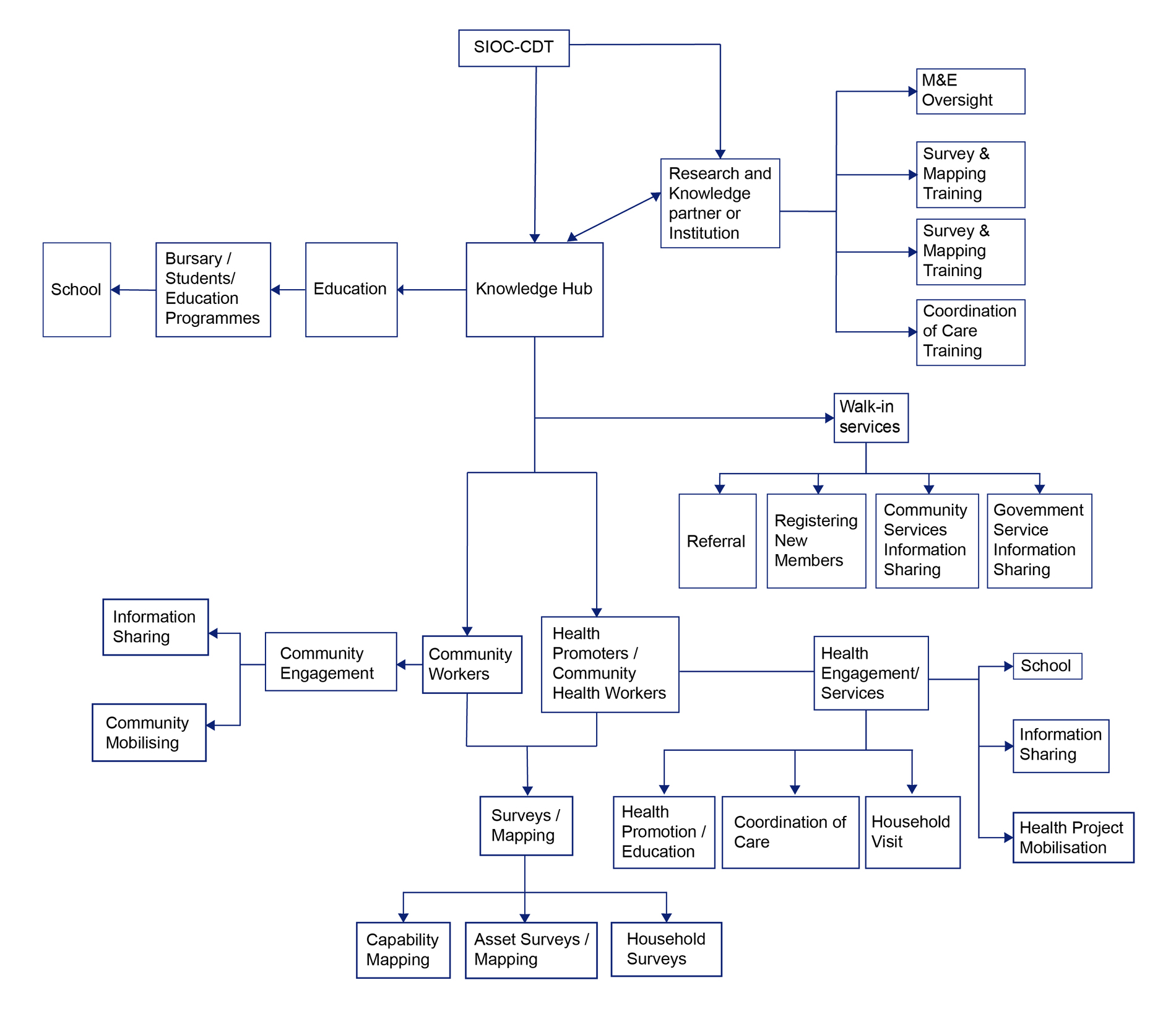
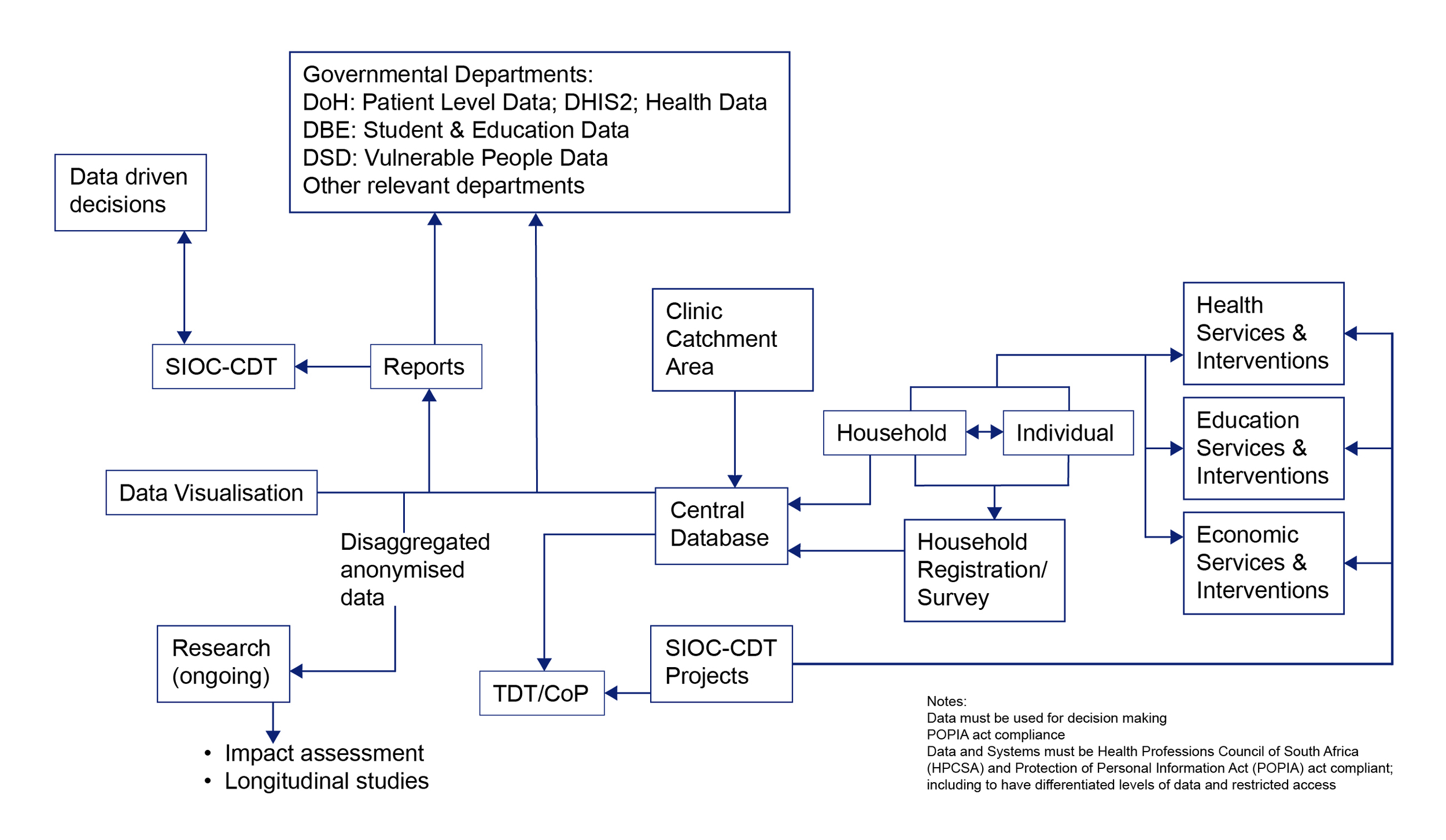
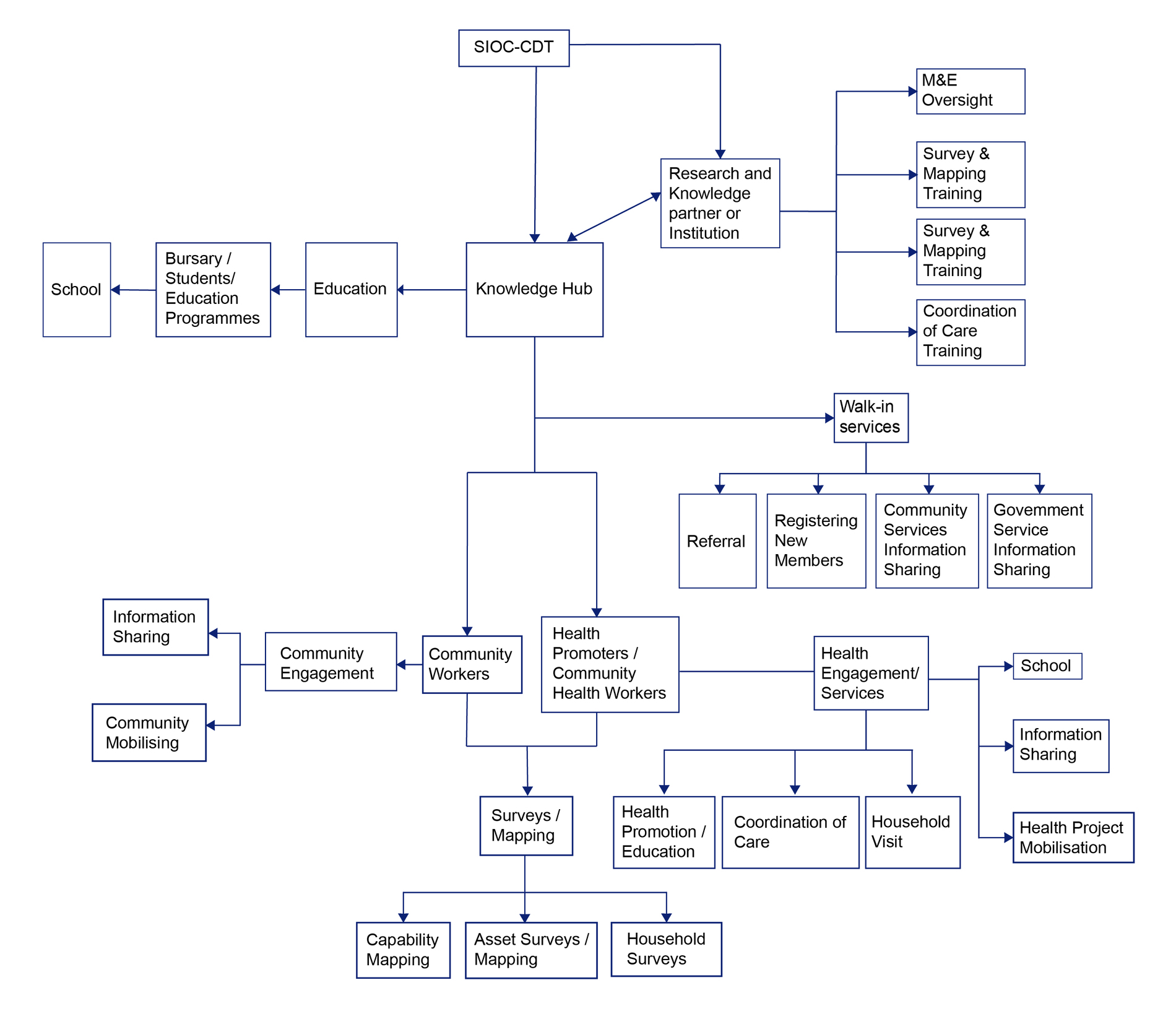
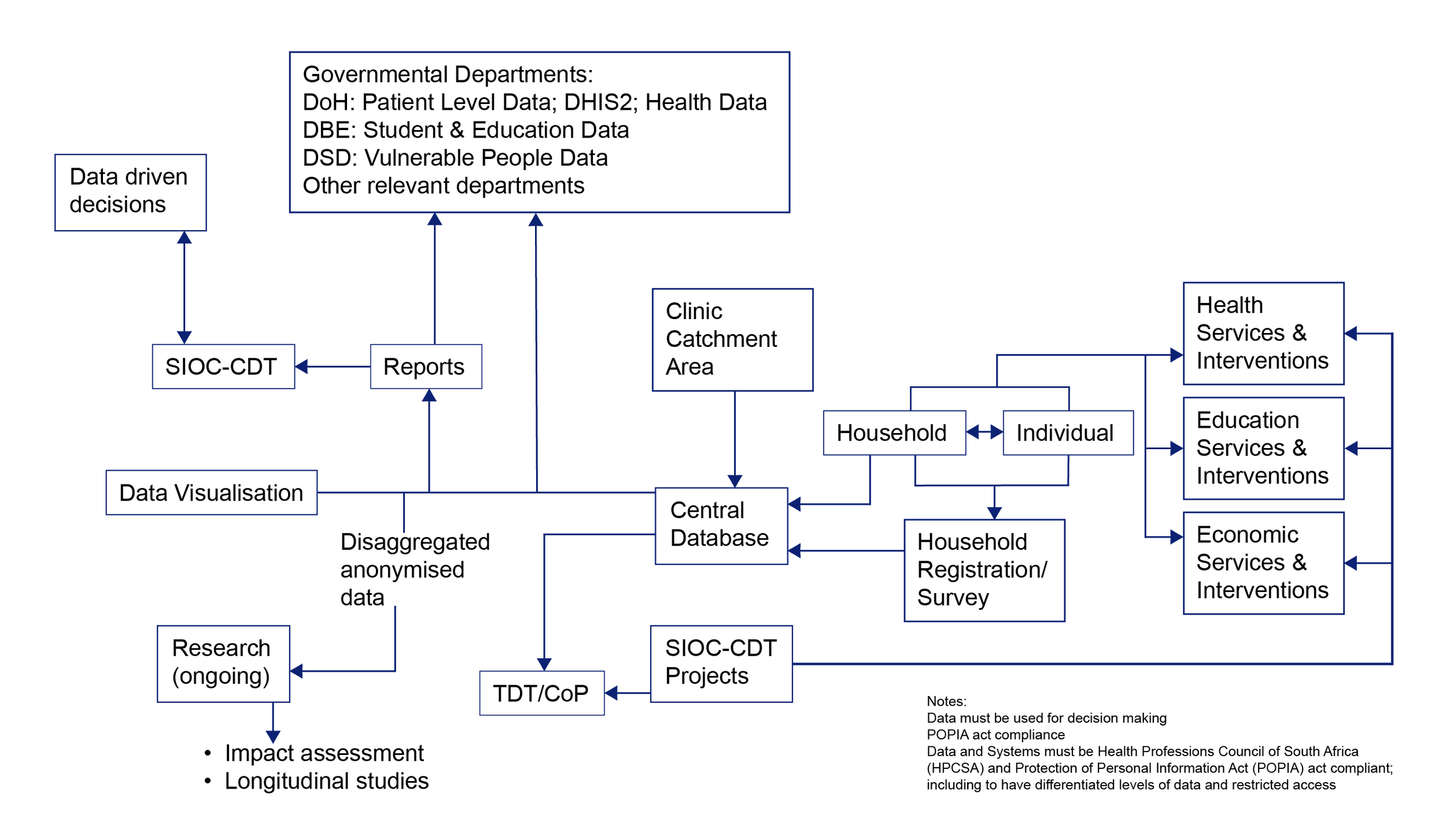
The Knowledge Hub was conceptualised as a community-based centre across the five municipalities, integrating health, education and economic development; supporting household-level data collection linked to CHWs or health promoters; facilitating coordinated outreach, referrals and follow-up; and providing a platform for community participation and co-design (Figure 1). Multidisciplinary teams (MDTs) were envisaged as monthly virtual or hybrid forums of SIOC-CDT staff, implementing organisations and DoH staff to review community-level data, resolve system bottlenecks, align activities with district health plans, and strengthen shared learning. The information architecture underpinning both (linking household registration and clinic catchment area assessment to a central database that supports service coordination, reporting and decision-making) is shown in Figure 2. Together, these proposals give organisational form to COPC’s emphasis on defined populations, household-based care and multidisciplinary collaboration. Their uptake is tracked in the follow-up survey (Table 4).
Follow-up survey: findings
Awareness of the assessment report and recommendations
Awareness differed sharply by role. Three SIOC-CDT staff had received the report and two were aware of the recommendations. Among government officials (n = 7), three had received it and three were aware. Among NGO/CBO implementers who were the largest group (n = 15) and primary delivery agents, only two had received the report and only two were aware. The people responsible for implementing the recommendations were, as a group, the least informed about them, with direct implications for the low implementation rates reported below.
Sharing and dissemination of the report
Dissemination beyond the initial recipient was limited; 67% of respondents reported not sharing the report with anyone. Open-text responses confirmed the gap: “Please send me the report”, and: “I couldn’t answer any of the questions because I had no context or understanding of them”, and were indicative of the dissemination failure among implementers.
Implementation status of the recommendations
Table 4 reports implementation status across all 14 recommendations. A total of 205 valid ratings were recorded across all respondents and all recommendations.
Across all 14 recommendations, ‘not applicable’ predominated (42%), followed by ‘not implemented’ (28%); active implementation (full or partial) accounted for just 18% (Table 4).
Critically, the high ‘not applicable’ rate should not be read as evidence that recommendations are irrelevant. Qualitative responses clarify that many respondents selected ‘not applicable’ precisely because they had not seen the report or recommendations and therefore had no basis for rating them. One respondent noted explicitly: “I couldn’t answer any of the questions because I had no context or understanding of them – so I just selected not applicable.” This conflation of non-receipt with non-applicability means that the 28% ‘not implemented’ figure is likely an undercount of true non-implementation.
Variation by recommendation
Recommendations 3 (central data system) and 4 (standardised reporting template) both recorded seven ‘not implemented’ ratings and negligible full implementation. One SIOC-CDT respondent noted that a proposal for a centralised data system had been submitted but declined, indicating organisational resistance rather than mere inertia. Recommendation 6 (MDT webinars) attracted revealing commentary: barriers included budget constraints, time pressures and scepticism: “People have other ways to get their CPD. No need to meet monthly”; one planned session was cancelled and never rescheduled: “We never received a follow-up after the discussion we were invited to was cancelled”. Recommendation 12 (Knowledge Hub) recorded no full or partial implementation (62% ‘not applicable’ and 23% ‘not implemented’) though two respondents indicated it was planned, suggesting the idea has not been abandoned.
Variation by respondent role
Implementation rates followed a clear gradient: highest among SIOC-CDT staff, intermediate among NGO/CBO implementers, and lowest among government officials, reflecting structural differences in report reach and authority to act.
Discussion
COPC as a system lens rather than a programme label
COPC provided a structured way of asking whether the HW portfolio collectively added up to a COPC system, shifting attention from individual outputs towards population definition, household engagement, equity and integration around users. While individual project elements aligned with COPC principles, key system features were absent: populations lacked clear denominators; household engagement remained partial; data rarely fed back into joint planning, and integration depended on informal relationships rather than structured MDT processes. COPC should be understood not as a label attached to projects but as an organising framework for system design, governance, and community experience.
Working with, rather than against, complexity
The evaluation confirmed that SIOC-CDT’s HW portfolio operates as a complex adaptive system, with several implications.
First, linear impact attribution is unrealistic. Multiple overlapping interventions, shifting policies, and fragmented data make it impossible to assign outcomes to single projects; attempting to do so produces misleading rather than merely imprecise claims. This constraint is structural rather than incidental. Because none of the projects maintained a household-level baseline or a defined denominator population, there was no bounded population against which coverage could be measured or outcomes attributed. In COPC terms, where the household is the unit of care and analysis, population-level outcomes cannot be defined without such data, let alone evaluated. The assessment therefore shifted deliberately from measuring outcomes to appraising the coherence, responsiveness, and adaptive capacity of the system itself.
Second, uncertainty and disagreement are inherent, not exceptional. SIOC-CDT initially sought clear project-level impact assessments,11 but the team judged these unfeasible without household-level data. This misalignment reflected different mental models in a complex system, requiring relational negotiation and co-learning.
Third, emergence is central. The Knowledge Hub and MDT models were not pre-specified but emerged through iterative engagement and joint reflection; the follow-up survey was itself an emergent component sustaining feedback loops beyond the formal evaluation.
Fourth, data gaps are triggers for learning rather than simply deficits. Flawed, uncertain, proximate and sparse26 data are the norm; the task is adaptive decision-making with available evidence, not waiting for better data.
Uptake of recommendations: slow, uneven and instructive
The follow-up survey underscores the challenge of translating complexity-informed recommendations into institutional practice. The fact that only a third of respondents reported receiving the report and that awareness of recommendations was limited suggests weaknesses in dissemination strategies and internal communication channels. The predominance of ‘not applicable’ and ‘not implemented’ ratings across the 14 recommendations indicates both contextual diversity and significant implementation gaps.
The presence of ‘planned’, ‘partially implemented’ and ‘fully implemented’ responses, while a minority, indicates that some stakeholders are actively engaging with recommendations within local constraints. In complex systems, change often begins as pockets of innovation that may or may not spread.
Why does household-level engagement keep failing?
Why, in a system with considerable investment, committed implementers and a supportive funder, do households remain peripheral?
The first is funder accountability. CSR- and SLP-funded programmes are accountable for outputs (beneficiaries reached, services delivered, events held) rather than household- or population-level outcomes. When survival depends on throughput at service points, the rational response is to maximise attendees at clinics, schools and outreach events: the modalities that aggregate people at fixed locations rather than following them into households.
The second is NGO contracting. Each HW project operates under a distinct contract with its own budget, reporting template and targets, creating powerful incentives for project-level rather than population-level thinking: implementers are rewarded for meeting their own targets, with no mechanism incentivising coordination around shared households or penalising duplicated effort.
The third is CHW deployment. CHWs and health promoters are best positioned to bridge the facility-household gap: they live in communities, are known to households, and provide the continuity COPC requires. In the SIOC-CDT setting, CHW involvement exists across several projects, but integration into a coherent outreach structure is absent, reflecting national weaknesses in CHW policy: fragmented deployment, inadequate supervision, unclear career pathways, and uneven integration into ward-based PHC outreach teams (WBPHCOTs).35
The fourth is health information architecture. South Africa’s public health infrastructure is organised around facilities and encounters, not households or defined populations, and NGO- and CSR-funded projects add their own monitoring systems, further fragmenting the data landscape. Without household-level data, the equity and comprehensiveness dimensions of COPC (are we reaching the most marginalised?) cannot be answered.
The problem is systemic: incentive structures, contracting arrangements, workforce models, and information architectures all orient effort away from the household. Redesigning these architectures, not merely adding household engagement as a project objective, is the required response.
The Knowledge Hub in relation to South African PHC policy
The most immediate policy relationship is with WBPHCOTs18 that are the national vehicle for COPC at ward level and comprise geographically defined CHW teams conducting household visits, health promotion, screening, and referral.18 The Hub shares this functional logic. Where WBPHCOTs are functional, the Hub should be conceived as an intersectoral extension, linking CSR-funded projects into the state’s community health infrastructure. Where they are absent, the Hub may need to perform WBPHCOT functions by default.
The second relationship is with the national CHW strategy. These are not two separate policy tracks: WBPHCOTs are the operational vehicle through which the national CHW programme is delivered at ward-level, so the Hub’s alignment with one implies alignment with the other. South Africa’s CHW policy envisions CHWs as salaried public servants integrated into the district health system. The Hub model is structurally aligned with this direction, but SIOC-CDT cannot employ CHWs directly. A viable model coordinates between state-employed CHWs and Trust-funded implementing organisations, with the district DoH as co-architect.
Third, the Hub has underexplored relevance to the National Health Insurance Act 20 of 2023 (NHI).36 Under the NHI framework,36 non-personal health services (outreach, health promotion, prevention) remain a provincial and district responsibility outside NHI Fund contracting, which prevents an integrated COPC-based system. This is precisely where CSR-funded programmes could contribute: positioned to coordinate these services across CSR, NGO and state actors in a defined area, the Hub could prototype the intersectoral, district-managed integration that NHI-era PHC requires but lacks mechanisms to achieve.
Finally, the MDT model envisions district DoH officials joining monthly review processes alongside Trust staff and implementing organisations, a governance proposition that asks the state to recognise a private trust’s coordination structure as a legitimate forum for joint planning.
The Hub does not propose something alien to South African policy; rather, it proposes a specific configuration (intersectoral, trust-anchored, geographically defined, data-enabled) that gives local form to national PHC policy directions. Its viability depends on whether it is designed with, rather than alongside, the institutions the policy intends to strengthen.
Limitations of the case and its interpretation
First, the evaluation is embedded in a particular relational and temporal context. The research team’s positionality, SIOC-CDT’s organisational culture, and the broader political environment all shaped what was possible. The case offers a situated example, not a universal blueprint. Second, the follow-up survey sample is small and subject to self-selection bias; results should be interpreted as indicative patterns rather than definitive measures. Third, community voice in this case study is almost entirely mediated: perspectives are present through implementing organisation staff, DoH officials, and SIOC-CDT personnel rather than through direct household engagement. For a paper arguing that households are the decisive site of care, this limits what can be claimed about community experience of the portfolio. Future evaluation of the Hub should place direct community voice at the centre of its design.
Relatedly, traditional health practitioners (frequently the first point of contact for illness in these communities) featured only as a listed stakeholder rather than as substantively engaged participants. A comprehensive, COPC-aligned Hub would need to build deliberate collaboration with traditional healers into its design, both to reflect how care is actually sought and to strengthen referral and follow-up pathways.
A further limitation is methodological. Although the analysis was explicitly complexity-informed, it did not employ formal systems methods such as causal-loop diagramming, system-dynamics modelling or social network analysis. Applying these would have made the feedback loops, dependencies and coordination structures described here more explicit and testable, and represents a clear direction for future work. Finally, the Hub and MDT models were concepts at the time of writing. The case can therefore speak to their design and early uptake, not yet to their long-term impact.
Lessons learnt
Several lessons follow for funders, implementers, government and researchers in mining-affected and other complex settings. Fragmentation is the default: without deliberate structures, mining-related health investment splinters into parallel projects, so integration around defined populations must be intentionally designed. COPC’s nine principles offer a practical evaluative scaffold that reveals gaps in population definition, household engagement, equity, and data integration that are invisible when projects are assessed individually. Complexity is a reality to work with rather than a problem to solve, directing evaluation towards relationships, feedback and adaptation rather than linear attribution. Household-level engagement, placing CHWs, household data and case management at the centre of design, is decisive for sustainable impact, and shared information systems must enable learning, not just reporting. Finally, transdisciplinary and relational work is both an ethical and a practical necessity; evaluation can itself be a form of intervention; and translating recommendations into practice needs its own intentional, multi-channel and accountable strategy.
Conclusion
The SIOC-CDT Health and Wellness portfolio in the NC and LP shows both the promise and the difficulty of building integrated COPC health systems in mining-affected communities. Applying COPC and complexity theory through transdisciplinary practice make it possible to move beyond a project-by-project view towards a systemic understanding of gaps, relationships, and possibilities: the capacity of a system to learn about itself and adapt, rather than merely report. The resulting Hub and MDT model offers a concrete, context-sensitive path for aligning mining-linked investment with public PHC systems and community priorities.
At the same time, the survey reveals how slowly and unevenly systemic recommendations diffuse through complex institutional landscapes. To realise their potential, COPC and complexity-informed approaches must be embedded in sustained, relational, transdisciplinary work, not only in evaluation designs and frameworks but in the everyday practices of funders, implementers, government officials and communities.